
What Is a DevOps Engineer? (The Honest, No-Buzzword Answer)
Let me start with something most articles won’t tell you.
When I first heard the term “DevOps Engineer” about ten years ago, I thought it was just a fancy title for system administrators who learned to code. Turns out, I was half right. And half very wrong.
The confusion makes sense though. Ask five DevOps engineers what they do, and you’ll get five different answers. One will talk about cloud infrastructure. Another will mention CI/CD pipelines. A third will complain about fixing someone else’s broken deployment at 11 PM.
So let me clear this up properly.
A DevOps engineer is someone who bridges the gap between developers (who write code) and operations teams (who run that code in production). But that definition is useless without context, so let me explain what that actually means day-to-day.
Imagine a software company. Developers write new features, test them on their own machines, and say “works for me.” Then they hand the code to operations. Operations tries to deploy it, discovers it doesn’t work on the actual servers, and sends it back. Developers get frustrated. Operations gets frustrated. Customers get nothing.
DevOps eliminates that fight.
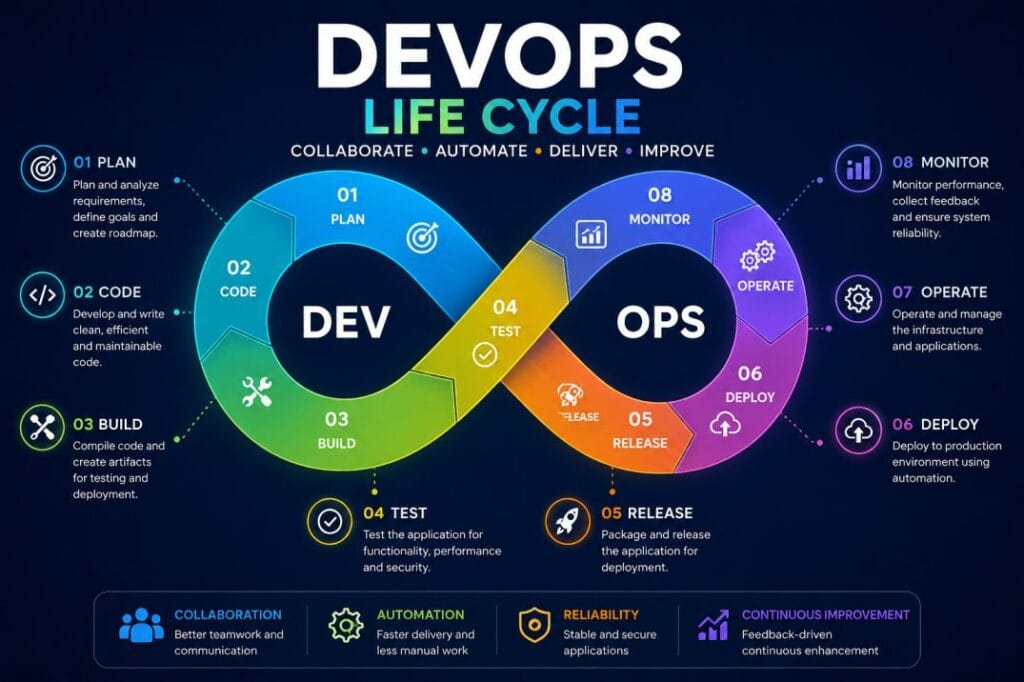
The DevOps engineer builds automated systems so that code moves from a developer’s laptop to production smoothly, safely, and quickly. They write scripts that test code automatically, package it, deploy it, monitor it, and even roll it back if something breaks.
But here’s what nobody tells beginners.
Most DevOps engineers didn’t start as DevOps engineers. Because ten years ago, the role barely existed. People moved into it from development, system administration, or even quality assurance. And that matters because it means there’s no single “right” path in.
The job also looks different at every company. At a startup, you might be the only person handling cloud, deployments, monitoring, and security. At a large company, you might spend six months just optimizing one tiny piece of their build pipeline.
So when someone asks me “what is a DevOps engineer,” I usually answer with a question back: “What do you want your day to look like?”
Because DevOps can mean solving interesting problems, automating boring tasks, learning constantly, and occasionally pulling your hair out at 2 AM. It’s rewarding. It pays well. And it’s also genuinely hard to learn if you’re starting from zero.
Let me walk you through what you’re actually signing up for.
Who Should Actually Become a DevOps Engineer?
Not everyone. And I mean that sincerely.
I’ve seen people jump into DevOps because they heard about the salaries, only to burn out within a year. I’ve also seen former English majors become incredible DevOps engineers because they had the right mindset. So let me be specific about who thrives here.
You’ll probably enjoy DevOps if:
- You like knowing how entire systems work, not just one small piece
- Breaking things doesn’t scare you (as long as you can fix them)
- You find repetitive tasks annoying enough to automate them
- Learning new tools every few months feels exciting, not exhausting
- You can handle ambiguous problems with no clear answer
- Explaining technical concepts to non-technical people doesn’t drain you
You might struggle with DevOps if:
- You prefer deep focus on one programming language or framework
- Uncertainty makes you uncomfortable
- You want clear instructions for everything
- Interruptions and context switching drive you crazy
- You don’t enjoy documenting what you built
Here’s a reality check I give everyone who asks me about this career.
The job involves a lot of debugging. Like, a lot. You’ll stare at logs. You’ll wonder why a server stopped responding. You’ll realize you forgot to configure something obvious. And you’ll do this repeatedly. If that sounds miserable, DevOps will be rough.
But if solving puzzles feels satisfying, if you get a little thrill when an automation script finally works, if you enjoy building systems that make everyone else’s job easier — then DevOps might be exactly right.
One more thing. DevOps engineers need what I call “comfortable discomfort” with the command line. You don’t need to be a terminal wizard on day one. But if GUIs are the only way you can work, you’ll hit a wall fast.
Skills You Actually Need (Not the 50-Tool Fantasy)
Look at any DevOps job posting and you’ll see a list of 30 tools. It’s intimidating. It’s also mostly nonsense.
No company expects you to know everything on day one. Job descriptions are wishlists. What you actually need are foundational skills that transfer across tools. Learn those, and picking up specific tools becomes much easier.
Technical Skills (Start Here)
Linux fundamentals — Non-negotiable. Most servers run Linux. You need to navigate the filesystem, edit files, manage processes, understand permissions, and read logs. That’s it for starters. You don’t need to compile kernels or become a distribution historian.
Scripting — Bash and Python. Bash for glue code and system tasks. Python for anything more complex. You don’t need to build web applications. But you need to read files, parse logs, call APIs, and automate repetitive tasks.
Networking basics — IP addresses, DNS, HTTP/HTTPS, load balancers, firewalls, SSH. You don’t need a networking certification. But when something can’t connect, you should know where to look.
One cloud platform — AWS, Azure, or GCP. Pick one. Learn compute (VMs or containers), storage, networking, and IAM (permissions). The concepts transfer. I usually recommend AWS first because it has the most learning resources.
Containers — Docker specifically. Understand images, containers, registries, volumes, and networking. You don’t need Kubernetes on day one, but know what containers are and why they matter.
CI/CD concepts — Continuous Integration and Continuous Delivery. Understand the pipeline: code commit, automated test, build, deploy. The specific tool (Jenkins, GitHub Actions, GitLab CI) matters less than the pattern.
That’s your core. Everything else — Kubernetes, Terraform, Ansible, Prometheus, whatever the next hot tool is — builds on these foundations.
Soft Skills (Where Most People Actually Struggle)
The technical side is straightforward to learn. The soft skills are what trip people up.
Communication — You’ll translate between developers, operations, security, and product managers. Each group speaks a different language. You need to explain why a deployment failed without blaming anyone and without drowning people in technical jargon.
Patience — Things break. You’ll fix the same issue three different ways before finding the root cause. Rushing makes everything worse.
Documentation — Write down what you built and why. Your future self will thank you. So will the person on call after you.
Curiosity — The tools change constantly. If you need formal classes to learn everything, you’ll fall behind. The best DevOps engineers just figure things out by reading docs, experimenting, and breaking things in safe environments.
Here’s an honest admission. I’ve interviewed DevOps candidates with perfect technical checklists who couldn’t work through a simple debugging problem because they froze without clear instructions. And I’ve hired people who knew maybe half the tools but asked smart questions and stayed calm when things broke.
Guess which group performed better?
Learning Paths: Degrees, Certifications, or Self-Taught?
Let me save you some anxiety.
You don’t need a computer science degree to become a DevOps engineer. Most of the DevOps engineers I know didn’t study it in school because the field didn’t exist when they graduated.
But you do need technical fundamentals. Here’s how people actually break in.
Formal education path (traditional but not required)
A CS or IT degree helps with the basics — programming, networking, operating systems. It won’t teach you DevOps specifically. Most universities don’t. You’ll still need self-study. The degree mainly helps with immigration (visa requirements) and getting past HR filters at traditional companies.
Certification path (useful but overrated)
Certifications prove you studied something. They don’t prove you can do the job. The AWS Certified Solutions Architect Associate is genuinely useful for learning cloud concepts. The CKA (Certified Kubernetes Administrator) matters if you work heavily with Kubernetes. Everything else? Nice to have but rarely decisive.
Self-taught path (increasingly common)
This is how most career-switchers actually succeed. You learn Linux, scripting, cloud, and containers on your own. Build projects. Document everything. Apply for junior roles or adjacent positions (support engineer, junior sysadmin, cloud support associate). Then grow into DevOps.
The self-taught path works because DevOps values demonstrated ability over credentials. If you can show me a working CI/CD pipeline you built, explain why you made certain choices, and troubleshoot when I break it — I don’t care about your degree.
The hybrid approach (what I actually recommend)
Take a structured course for fundamentals (AWS certification training, Linux basics, Python for automation). Then build projects immediately. Use free tier cloud accounts. Break things intentionally. Fix them. Document what you learned.
This combines the efficiency of guided learning with the practical skill-building that actually matters for interviews.
Step-by-Step Roadmap (Realistic Timeline)
Let me give you a timeline that won’t set you up for disappointment.
Months 1-3: Foundations
Learn Linux basics (Ubuntu or CentOS). Master the command line — navigating, editing files with vim or nano, managing processes, reading logs. Learn Bash scripting for basic automation. Learn Python basics — variables, loops, functions, file handling, working with APIs.
By month three, you should be comfortable in a terminal and able to write a script that reads a file, processes the data, and outputs results.
Months 4-6: Core Tools
Learn Docker. Build containers for simple applications. Understand images, volumes, networking, and docker-compose. Learn one cloud platform — start with AWS free tier. Launch EC2 instances. Use S3 for storage. Understand security groups and IAM roles.
Learn Git. Not just committing code — branching, merging, resolving conflicts, pull requests. This matters more than you think.
By month six, you should containerize a simple web app, run it locally, and deploy it to a cloud VM.
Months 7-9: CI/CD and Automation
Learn a CI/CD tool — GitHub Actions is easiest to start. Build a pipeline that runs tests on code push, builds a container, and deploys to a dev environment. Learn infrastructure as code — Terraform is the standard. Write Terraform to provision cloud resources instead of clicking in a console.
Learn basic monitoring — understand metrics, logs, and alerts. Set up a simple dashboard.
By month nine, you should have an automated pipeline that deploys your application from code commit to running server with zero manual steps.
Months 10-12: Advanced Topics and Job Prep
Learn Kubernetes basics if you want — pods, deployments, services. This becomes relevant for many roles but isn’t mandatory for junior positions. Build a portfolio with 3-4 projects. Document everything on GitHub with clear READMEs. Write about what you built and why.
Practice interview questions. Build a resume that emphasizes projects over job titles if you’re switching careers. Apply for junior DevOps roles, cloud support engineer roles, or site reliability engineer (SRE) positions.
Realistically, expect this to take 9-12 months of consistent study (10-15 hours per week). Faster if you study full-time. Slower if you have work or family obligations. That’s fine. Consistency beats intensity.
Best Learning Resources (That Actually Work)
I’ve wasted money on overpriced courses. Here’s what’s genuinely worth your time.
Free Resources
- Linux Journey — Interactive Linux learning for absolute beginners
- OverTheWire Bandit — Gamified Linux command line practice
- Python for Everybody (freeCodeCamp) — Excellent Python fundamentals
- Docker’s Official Get Started Guide — Better than most paid courses
- AWS Free Tier — Hands-on practice with real cloud services
- GitHub Actions Documentation — Surprisingly good and practical
Paid Resources (Worth the Money)
- Adrian Cantrill’s AWS Courses — Deep, practical, and exam-relevant
- KodeKloud — Hands-on labs for DevOps tools (worth every dollar)
- A Cloud Guru — Good for breadth, less depth than Cantrill
- Python Crash Course (book) — Still the best beginner Python book
Communities
- r/devops — Good for news and occasional advice
- DevOps Stack Exchange — Specific technical questions
- Local cloud user groups — In-person networking helps more than you’d think
What to Avoid
Don’t buy “DevOps bootcamps” promising jobs in 12 weeks. I’ve reviewed several. Most are overpriced YouTube tutorials. Don’t collect certifications without building projects. Don’t spend months “learning” without building anything real.
Common Beginner Mistakes (Learn From Others)
I’ve watched hundreds of people try to break into DevOps. Here’s where most of them go wrong.
Mistake 1: Learning tools instead of fundamentals
Someone learns Kubernetes but doesn’t understand Linux permissions. Then they can’t debug why their pod can’t write to a volume. Learn the fundamentals first. Tools change. Concepts don’t.
Mistake 2: No portfolio projects
Resumes that just list “skills” go in the trash. Resumes with links to GitHub projects and working deployments get interviews. Build something. Break it. Fix it. Document it.
Mistake 3: Following tutorials without understanding
Copy-pasting Terraform code from a tutorial teaches you nothing. Type it yourself. Change values intentionally. See what breaks. Read the error messages. That’s how learning happens.
Mistake 4: Ignoring soft skills
I’ve rejected technically brilliant candidates who couldn’t explain their thought process or got defensive when asked about trade-offs. Practice explaining your work out loud. To a friend. To a rubber duck. To your dog. It matters.
Mistake 5: Applying too early
Junior DevOps roles still expect basic competence. If you can’t debug a simple connectivity issue or explain what happens when you type https://google.com in a browser, you’re not ready. Build more projects first.
Mistake 6: Comparing yourself to senior engineers
That person with 10 years of experience wasn’t born knowing this stuff. They struggled through the same learning curve. Focus on your own progress.
Salary, Jobs, and Future Scope (Real Numbers)
Let me give you honest numbers, not the inflated ones you see on TikTok.
Entry-level (0-2 years experience)
In the US: 70,000−100,000
In India: ₹5,00,000 – ₹12,00,000
Remote international: 20,000−50,000 depending on location
Mid-level (2-5 years)
US: 100,000−140,000
India: ₹12,00,000 – ₹25,00,000
Senior (5+ years)
US: 140,000−180,000+ (higher in FAANG)
India: ₹25,00,000 – ₹45,00,000+
These are realistic ranges. Some people earn more. Some earn less. Location, company size, negotiation, and actual skills all matter.
Job market reality
Demand remains strong, but entry-level is competitive. Companies want junior DevOps engineers who can be productive with guidance. They don’t expect expertise. They do expect fundamentals.
The role isn’t going away. As long as companies run software, someone needs to build and maintain the systems that deploy and operate it. That said, expect the specific tools to keep changing. Kubernetes won’t be the hot thing forever.
Remote opportunities
DevOps lends itself well to remote work. Many teams are fully distributed. This expands your job market but also increases competition. A candidate from a low-cost region can underbid someone from a high-cost region. Focus on skill quality, not just price.
Realistic Career Advice (What Actually Matters for Success)
After a decade in this field, here’s what I wish someone had told me earlier.
The job involves more meetings than you expect
DevOps isn’t just technical work. You’ll spend time in planning sessions, incident reviews, and cross-team coordination. If you want to hide in a corner and only touch keyboards, this isn’t the role.
On-call is real
Most DevOps roles include on-call rotation. You might get paged at 3 AM because something broke. Good teams minimize this with better systems. Bad teams treat it as normal. Ask about on-call during interviews.
Imposter syndrome never fully goes away
The field changes too fast to know everything. Senior engineers still encounter things they don’t understand. The difference is they’ve learned how to figure things out without panicking. You’ll develop that too.
Automation is the point, not the tool
Don’t automate something just because you can. Automate because it saves time, reduces errors, or enables something impossible manually. Know the difference.
Security matters more than ever
DevOps and security are merging into DevSecOps. Basic security knowledge — least privilege, secrets management, vulnerability scanning — makes you much more valuable.
The best career insurance is continuous learning
Spend an hour each week reading about what changed. Follow one or two newsletters. Experiment with new tools in a free cloud account. Small consistent effort beats cramming every few years.
Your first job will teach you more than any course
Get into the industry somehow — even as a support engineer or junior sysadmin — and learn from real systems. Theory only takes you so far.
FAQs
Do I need to know how to code to become a DevOps engineer?
Yes, but not like a software engineer. You need scripting skills — automating tasks, working with APIs, parsing logs, deploying code. Python and Bash cover most needs. You don’t need data structures and algorithms or web frameworks.
Is DevOps harder than software development?
Different hard. Development requires deep focus on business logic and user experience. DevOps requires broad knowledge across networking, systems, security, and automation. Neither is objectively harder. Choose based on what you enjoy.
Can I become a DevOps engineer without experience?
Yes, but you need demonstrable skills. Build projects. Document them. Apply for junior roles or adjacent positions (cloud support, junior sysadmin). Many successful DevOps engineers started elsewhere and transitioned after building skills.
How long does it really take to learn DevOps?
Realistically, 9-12 months of consistent part-time study to reach junior level. Faster if you study full-time. Slower with work and family commitments. Ignore anyone promising 12-week transformations.
Which cloud platform should I learn first?
AWS has the most learning resources and job opportunities. Azure is strong in enterprise environments. GCP is smaller but growing. Start with AWS. The concepts transfer.
Do I need Kubernetes to get hired as a junior?
No. Many junior DevOps roles don’t use Kubernetes at all. Focus on Linux, scripting, cloud fundamentals, and CI/CD. Add Kubernetes after you have those foundations.
Is DevOps stressful?
Sometimes. On-call rotations and production incidents create pressure. Good teams build systems to reduce stress. Bad teams treat heroics as normal. Interview the company culture as much as they interview you.
Can DevOps be outsourced easily?
Parts can be outsourced, but companies usually keep core DevOps in-house because it requires deep understanding of their specific systems and processes. The role evolves toward higher-level automation and consulting rather than disappearing entirely.
Conclusion
Here’s what you actually need to know.
DevOps engineering is a real, well-paying career that isn’t going away. It rewards curiosity, patience, and practical problem-solving. It punishes people who just want to follow instructions and never learn new things.
You don’t need a computer science degree. You don’t need to know 50 tools. You do need Linux fundamentals, scripting skills, cloud basics, and the ability to debug things when they break.
Start with the roadmap I gave you. Build projects. Document everything. Apply when you can actually demonstrate skills, not just list them.
And remember — every experienced DevOps engineer started exactly where you are now. Confused. Intimidated by the tool list. Not sure if they were smart enough.
They figured it out one step at a time. So will you.
Your next step: Open a terminal today. Learn five Linux commands. That’s it. Small progress every day beats waiting for the perfect plan.
2 thoughts on “What Is a DevOps Engineer? (And Why Everyone Explains It Wrong)”
Comments are closed.