
Introduction: Why Most “BA” Guides Are Lying to You
Let me start with a confession.
When I first searched for “business analyst roles and responsibilities” ten years ago, I found neat little lists. Communicate. Document. Analyze. Test. It looked clean, almost easy.
Then I actually became one.
My first week on the job, a project manager handed me sixty pages of meeting notes and said, “Figure out what they actually want. The developers are waiting.”
Nobody had taught me that the client’s “small change” would break three other systems. Nobody warned me that the developers would question every single line of my requirements. And nobody told me that sometimes, the smartest thing you can do is say “I don’t know, but I will find out by tomorrow.”
This guide is not the polished version. This is what I wish I knew. And after mentoring over 200 aspiring BAs, I have seen what works and what wastes time.
Whether you are a college student, a working professional looking for a career shift, or someone who just heard “BA pays well and doesn’t need coding,” you need the truth first. The inspiration comes later.
Let me walk you through the real business analyst roles and responsibilities, without the fluff.
What Is a Business Analyst? (The Textbook Definition vs. Reality)
The Official Definition
A Business Analyst (BA) is a professional who identifies business needs, analyzes processes, and recommends solutions—often technology solutions—that help an organization achieve its goals.
That is what the BABOK Guide (Business Analysis Body of Knowledge) will tell you.
The Real-World Definition
A BA is the person who stops the company from building a $200,000 feature that nobody will use.
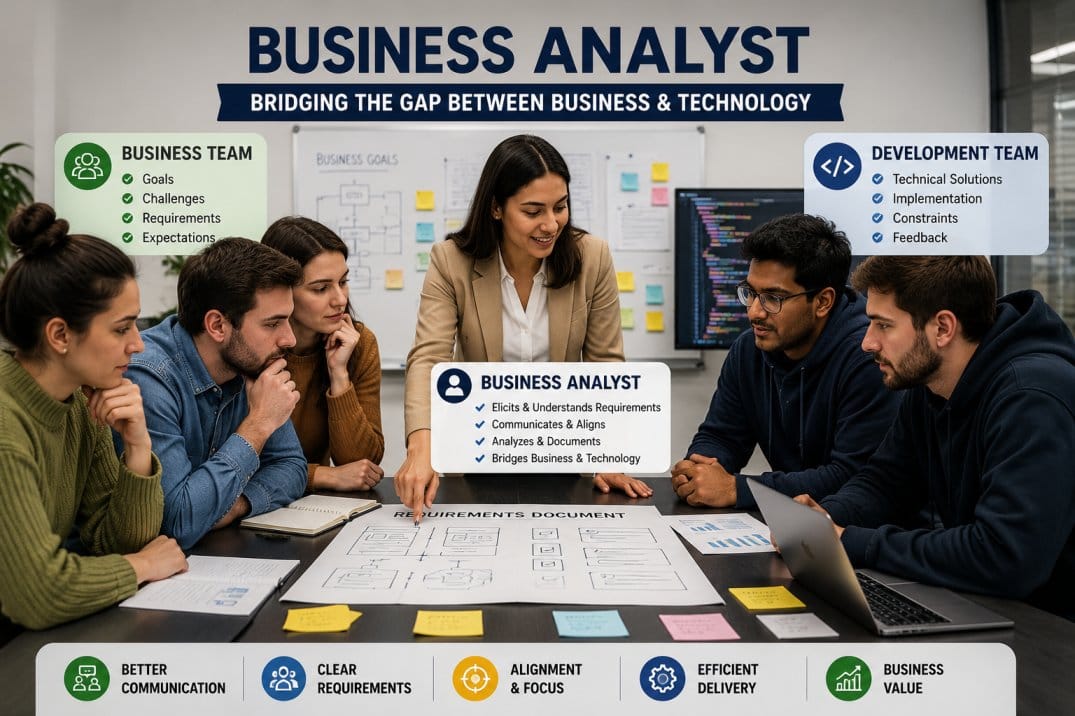
You are part detective, part diplomat, part writer, and part therapist. You listen to what people say they want, figure out what they actually need, and then write it down so clearly that a developer sitting in another country can build it correctly the first time.
Think of it this way:
- The business person says: “The website is too slow.”
- The developer hears: “Rewrite the entire backend.”
- The BA translates: “The average page load time is 4.2 seconds. The business requirement is under 2 seconds for 95% of users on mobile. Please prioritize image compression and API caching.”
Without the BA, the developer might spend three months rebuilding the wrong thing. With the BA, the team fixes the actual problem in two weeks.
The Daily Reality: A Typical Day (Hour by Hour)
Let me give you a real 9-to-5 example.
9:00 AM – Standup Meeting
You join the daily Agile standup. Developers share what they worked on yesterday. You listen for blockers. One developer says, “I’m confused about the ’email notification’ requirement. Does it trigger before or after payment confirmation?”
You note this down. Your job now is to get an answer by noon.
10:00 AM – Stakeholder Interview
You sit with a business manager who wants a “dashboard.” You ask: “What decision will you make using this dashboard?” They pause. “I want to see which products are selling slowly.” Great. Now you know they need inventory aging, not fancy charts.
11:30 AM – Documenting Requirements
You write user stories in JIRA. Not vague ones. Testable ones.
Example:
- Bad: “As a user, I want a fast report.”
- Good: “As a warehouse manager, I want to export the ‘low stock’ report as a CSV file within 10 seconds, so I can send it to suppliers before noon.”
1:00 PM – Lunch
You actually take it. Burnout is real.
2:00 PM – Process Mapping
You open Lucidchart. You map the current “customer refund” process. You find three manual approval steps that add two days. You draw a proposed flow that automates two of them.
3:30 PM – Requirements Review Meeting
You present your findings to the tech lead and the business sponsor. The tech lead says, “That automation will take 40 hours.” The sponsor says, “We only have 20 hours budgeted.”
You negotiate. You agree to automate the most painful step and leave the other two as manual for now.
5:00 PM – Follow-ups
You email the developer the clarification about email notifications. You update the JIRA ticket. You send meeting notes to the sponsor.
6:00 PM – Done
Notice: No coding. No “strategy presentations.” Just steady, practical, valuable work.
Who Should Choose This Career? (And Who Will Burn Out)
This is the most honest section. Read it twice.
You Will Likely Thrive If:
| Trait | Why It Matters |
|---|---|
| Curious, not judgmental | When a process is broken, you ask “why” instead of “who screwed up.” |
| Comfortable with gray areas | Requirements change. Stakeholders disagree. You don’t freeze. |
| Good at writing simply | You can explain a complex rule in one clear sentence. |
| Patient but persistent | You will ask the same question three different ways before getting a straight answer. |
| Detail-oriented | Missing one comma in an acceptance criterion can cost a week of rework. |
You Will Struggle If:
- You hate meetings. BA work is 50% meetings. If you dread Zoom calls, this is not for you.
- You need clear rules. Every organization has unique politics, legacy systems, and exceptions. No textbook prepares you for “Carol in accounting who refuses to use the new tool.”
- You take criticism personally. Developers will tell you your requirement is ambiguous. Stakeholders will say your document is too technical. You need a thick skin.
- You want quick wins. Projects run for months. Your contribution is often invisible until the very end.
A personal observation: The best BAs I have worked with previously were librarians, teachers, or customer support leads. Why? Because those roles teach you how to organize information, handle frustrated people, and explain things clearly. If you come from those backgrounds, you already have a head start.
Core Business Analyst Roles and Responsibilities (Detailed Breakdown)
Let me now give you the complete, granular list of what you will actually be responsible for. I have grouped them into categories.
1. Requirements Elicitation (Finding Out What People Need)
This is the most misunderstood skill. You do not just “ask questions.” You use specific techniques.
Common techniques:
- Interviews: One-on-one with stakeholders. You prepare questions, but you listen for what they are not saying.
- Workshops: Group sessions where you facilitate a discussion. Your job is to ensure the loudest person doesn’t dominate.
- Surveys: Useful when you need input from 50+ people. But surveys miss nuance.
- Document analysis: You read existing process manuals, old project documents, and system logs. Often, the truth is buried there.
- Observation: You sit next to a user doing their job. You watch what they actually do, not what they say they do.
Example: I once observed a warehouse worker who said he “always checks inventory in the system.” But when I watched, he actually walked to the shelf first, then checked the system. That discovery changed the entire requirements.
2. Requirements Documentation (Writing It Down)
This is where you earn your salary. You will produce several types of documents.
| Document Type | Purpose | Typical Length |
|---|---|---|
| BRD (Business Requirements Document) | High-level business needs and objectives. For executives. | 5-15 pages |
| FRD / FSD (Functional Requirements Document) | Detailed system behaviors. For developers and testers. | 20-100 pages |
| User Stories + Acceptance Criteria | Agile format: “As a [role], I want [action], so that [benefit].” | 1-3 sentences per story |
| Use Cases | Step-by-step interactions between user and system. | 1-2 pages per scenario |
| Process Flow Diagrams | Visual maps of workflows. BPMN or simple flowcharts. | 1 diagram per process |
The rule I teach my mentees: Write for the person who will read your document at 4:45 PM on a Friday. Make it obvious. No cleverness. No ambiguity.
3. Stakeholder Management (The Political Reality)
You will manage people who have no reporting authority over you. This is hard.
Your stakeholder map will include:
- Executives: They care about cost, timeline, and ROI. Speak in bullet points.
- Managers: They care about team efficiency and metrics. Speak in KPIs.
- End users: They care about ease of use and not losing their work. Speak in empathy.
- Developers: They care about clarity and feasibility. Speak in acceptance criteria.
- QA testers: They care about edge cases and testability. Speak in scenarios.
Practical tip: Create a simple RACI matrix for every project. RACI stands for Responsible, Accountable, Consulted, Informed. Share it in the first week. It prevents “I thought you were handling that” fights later.
4. Process Modeling (Seeing the Invisible)
You cannot improve what you cannot see. Process models make workflows visible.
Common notations:
- BPMN 2.0: The industry standard. Learn the basics of events, gateways, and activities.
- UML Activity Diagrams: Simpler than BPMN. Good for quick sketches.
- Value Stream Maps: Focus on time and waste. Popular in Lean methodologies.
A beginner exercise: Map the process of ordering a pizza from your favorite app. Include steps like “select toppings,” “enter payment,” “receive confirmation.” Then find three inefficiencies. That is the BA mindset.
5. Solution Validation (Did We Build the Right Thing?)
Your job does not end when development starts. You stay involved.
Activities:
- Writing test cases based on your acceptance criteria.
- Supporting QA by clarifying requirements.
- User acceptance testing (UAT): You help business users test the final product.
- Change requests: When stakeholders ask for new features mid-project, you analyze the impact.
A hard truth: You will be blamed if the final product fails. Even if the developer coded it wrong. Even if the tester missed a bug. That is why you review everything personally.
6. Facilitation and Negotiation (The Soft Skill That Pays)
You will run meetings. You will resolve conflicts.
Meeting types you will facilitate:
- Requirements workshops
- Joint Application Development (JAD) sessions
- Sprint planning and retrospectives (if acting as Product Owner)
- Go/no-go decisions
Negotiation scenarios:
- “We want feature X, Y, and Z” vs. “We only have budget for X and Y.”
- “The system must do this” vs. “That violates security policy.”
A script I use: “I hear that you want both speed and accuracy. Right now, we can optimize for one. Which one matters more for the launch?”
Skills Required: From Beginner to Industry-Ready
Technical Skills (The “Hard” Skills)
| Skill | Beginner Level | Industry Expectation (1-2 years) |
|---|---|---|
| SQL | Basic SELECT, WHERE, JOIN | Subqueries, aggregate functions, query optimization |
| Process Modeling | Simple flowcharts in Lucidchart | BPMN 2.0 with pools, lanes, events |
| Requirements Management | Writing user stories in a text file | Using JIRA, Confluence, or Azure DevOps |
| Data Analysis | Sorting in Excel | Pivot tables, basic statistical functions |
| Prototyping | Hand-drawn wireframes | Figma, Balsamiq, or Axure basics |
| Testing | Manual test case writing | Using TestRail, understanding regression testing |
Do you need Python? No. Do you need advanced statistics? No. Do you need SQL? Yes. That is the one non-negotiable technical skill for 90% of BA roles.
Soft Skills (The “Career-Making” Skills)
These are harder to learn but more valuable.
- Active listening: Paraphrase what someone said to confirm understanding. “Let me repeat that back to ensure I got it right…”
- Written communication: Use short sentences. Active voice. Avoid jargon unless your audience knows it.
- Critical thinking: Question assumptions. “Why do we do it this way?” “What happens if we don’t do it at all?”
- Time management: You will have multiple stakeholders demanding immediate attention. Learn to say “I will get back to you by end of day.”
- Emotional intelligence: Read the room. If the sponsor is stressed, save detailed questions for later.
Domain Knowledge (Your Competitive Advantage)
This is where you specialize and earn more money.
High-demand domains in 2026:
- Financial services: Banking, insurance, payments. Regulated. Slow-moving but high pay.
- Healthcare: Electronic medical records, insurance claims. Complex but rewarding.
- Supply chain and logistics: Inventory, shipping, warehousing. Growing fast post-pandemic.
- Retail and e-commerce: Customer experience, payments, fraud detection.
- Government and public sector: Slower pace but stable.
Strategy: Do not try to learn all domains. Pick one that interests you. Read industry news. Understand the basic terminology. That knowledge makes you irreplaceable.
Eligibility and Learning Paths (Degrees, Certifications, Self-Taught)
Formal Education Options
| Path | Time | Cost | Hiring Advantage |
|---|---|---|---|
| Bachelor’s in Business/IS | 3-4 years | High | High for large corporations |
| Bachelor’s in unrelated field + self-study | 1-2 years (extra) | Low-Medium | Medium |
| Master’s in Business Analytics | 1-2 years | High | High for senior roles |
| No degree + portfolio + certification | 6-12 months | Low | Medium (startups, contract roles) |
My honest advice: If you already have a bachelor’s degree in anything (history, psychology, communications), do not go back for a second bachelor’s. Learn skills, build a portfolio, and target entry-level roles. If you have no degree, get one part-time while working, but do not wait to start learning.
Certifications Worth Your Money (Ranked)
| Certification | Cost | Time | When to Get It |
|---|---|---|---|
| ECBA (IIBA) | ~$150 | 20 hours | Before applying for jobs (shows commitment) |
| CCBA (IIBA) | ~$450 | 50 hours | After 2-3 years of experience |
| CBAP (IIBA) | ~$550 | 80 hours | After 5+ years (senior roles) |
| PMI-PBA | ~$500 | 60 hours | If you also want project management |
| SQL Certification | $0-300 | 10-40 hours | During learning (validates technical skill) |
Avoid: “Master Business Analyst” certifications from unknown institutes. They are not recognized by employers.
Self-Taught Path (Step-by-Step)
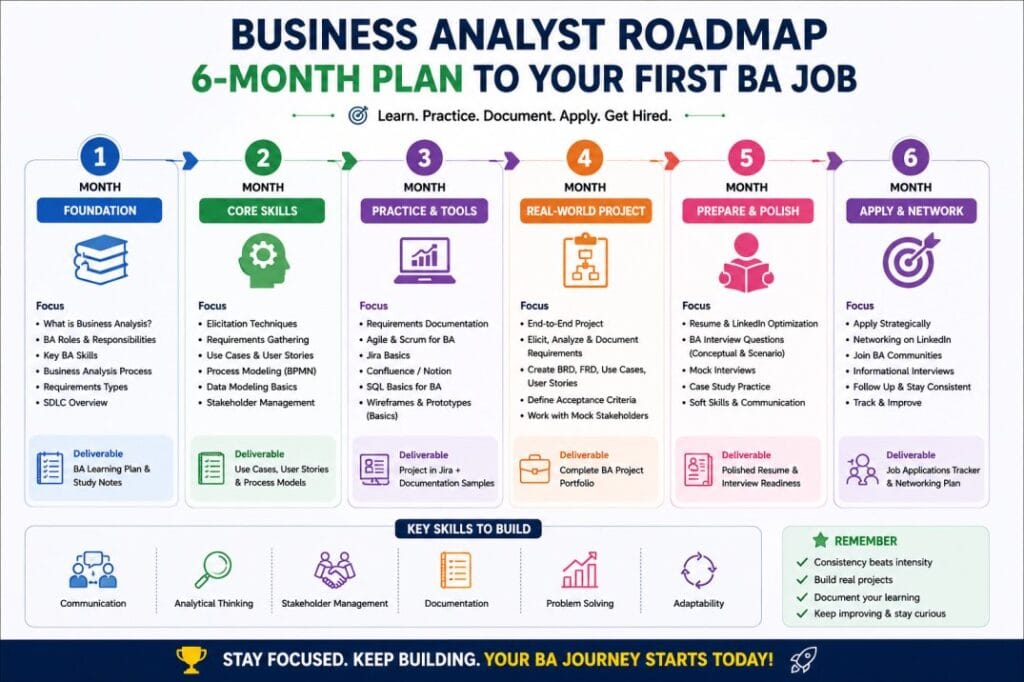
- Month 1: Learn the vocabulary. Read the BABOK Guide summary (free online). Watch “Business Analyst 101” videos on YouTube.
- Month 2: Learn SQL basics. Use SQLZoo or W3Schools. Practice every day for 30 minutes.
- Month 3: Learn a diagramming tool. Lucidchart has a free tier. Map three real processes from your life or work.
- Month 4: Write a sample requirements document. Use a template from Bridging the Gap. Pick a fake project (e.g., “Food delivery app for a campus”).
- Month 5: Join a community. IIBA has local chapters. Reddit’s r/businessanalysis is active. LinkedIn has BA groups.
- Month 6: Apply for internships, junior roles, or internal transfers. Target contract roles too.
Step-by-Step Career Roadmap (12 to 24 Months)
I will give you two paths: one for students and one for career changers.
Path A: For Students (Still in College)
Year 1 (While studying):
- Take electives in MIS, database management, or technical writing.
- Join the business club or tech club.
- Do one internship, even if it is unpaid or administrative. The exposure matters.
After graduation (Months 1-6):
- Study for ECBA. Take the exam.
- Build three portfolio pieces: a process map, a user story set, a SQL query that answers a business question.
- Apply to “Junior Business Analyst,” “Associate Analyst,” or “Operations Analyst” roles.
Months 7-12:
- If no full-time job, take a contract or temp role. Even data entry inside a tech company. Then internally network.
- Once hired, focus on learning the company’s specific domain.
Path B: For Career Changers (Working Professionals)
Months 1-3 (Evenings and weekends):
- Do not quit your job. Learn SQL (2 hours per weeknight, 5 hours on weekends).
- Identify if your current role has any process improvement opportunities. Volunteer for them.
Months 4-6:
- Take a Udemy course on Business Analysis ($15).
- Start applying to internal openings. Internal transfer is the easiest path. Your existing domain knowledge is valuable.
Months 7-12:
- If internal transfer fails, update your resume to highlight analysis-related tasks. Use BA keywords: “gathered requirements,” “documented workflows,” “liaised between teams.”
- Apply to external junior BA roles. Expect a pay cut if moving from a senior role in another field.
Months 13-18:
- Once in a BA role, spend your first 90 days learning before suggesting changes.
- After one year, decide if you want to stay technical (Senior BA, Product Owner) or move toward management (Project Manager, Product Manager).
Best Learning Resources (Curated List)
Free Resources (Start Here)
| Resource | What It Covers | Link (searchable) |
|---|---|---|
| SQLZoo | Interactive SQL tutorials | sqlzoo.net |
| Mode SQL Tutorial | Business-focused SQL | mode.com/sql-tutorial |
| Bridging the Gap (YouTube) | BA career and templates | Search on YouTube |
| IIBA Body of Knowledge (summary) | Core concepts | Google “BABOK summary PDF” |
| Reddit r/businessanalysis | Real Q&A from practitioners | reddit.com/r/businessanalysis |
Paid Courses (Under $50)
| Course | Platform | Best For |
|---|---|---|
| The Business Analyst Course 2026 | Udemy | Complete beginners |
| SQL for Business Analysts | Udemy | Technical skill |
| Business Process Modeling | LinkedIn Learning | Visual learners |
Books Worth Buying
| Book | Author | Why Read It |
|---|---|---|
| Software Requirements (3rd Edition) | Karl Wiegers & Joy Beatty | The complete reference. Keep it on your desk. |
| User Story Mapping | Jeff Patton | Agile requirements made practical. |
| The Business Analyst’s Handbook | Howard Podeswa | Quick reference for templates. |
Communities
- IIBA Local Chapters: In-person networking. Priceless for job referrals.
- BA Mentor Facebook Group: Free advice from experienced BAs.
- Women in Business Analysis (WIBA): Supportive and active.
Common Beginner Mistakes (And How to Avoid Them)
I have seen hundreds of aspiring BAs make the same errors. Here is how to bypass them.
Mistake 1: Learning Every Tool Before Applying
The error: “I need to master JIRA, Confluence, Visio, Lucidchart, Trello, Asana, and Monday.com before I apply.”
The reality: You only need to know one diagramming tool and one requirements tool. The rest you learn on the job in a week.
Fix: Pick Lucidchart (free) and JIRA (free tier). Stop there.
Mistake 2: Writing Requirements Like a Novel
The error: Long paragraphs, passive voice, and assumptions like “the system should be intuitive.”
The reality: Developers need atomic, testable statements. “Intuitive” is not testable.
Fix: Use the INVEST criteria for user stories: Independent, Negotiable, Valuable, Estimable, Small, Testable.
Mistake 3: Ignoring the “Why”
The error: Documenting every stakeholder request without questioning.
The reality: Half the requests are solutions in search of problems.
Fix: Ask “Why?” at least three times. “We need a new report.” Why? “To track sales.” Why? “Because the current report doesn’t include regional filters.” Great. Add filters to the existing report. No new report needed.
Mistake 4: Over-Engineering the Portfolio
The error: Building a 50-page document for a fake project.
The reality: Hiring managers spend 2 minutes scanning your portfolio.
Fix: Build three small perfect artifacts: one process diagram, one set of 10 user stories, one SQL query with explanation.
Mistake 5: Applying Only to “Business Analyst” Job Titles
The error: Filtering job boards by “Business Analyst” only.
The reality: Many junior roles have different titles but similar work.
Fix: Also search for: “Associate Product Owner,” “Quality Assurance Analyst,” “Operations Analyst,” “Systems Analyst,” “Requirements Analyst.”
Salary, Job Market, and Future Scope (Honest Data)
Fresher Salary Ranges (0-2 Years Experience)
| Location | Low End | Average | High End (top 10%) |
|---|---|---|---|
| India (INR) | ₹3,50,000 | ₹5,50,000 | ₹8,00,000+ |
| USA (USD) | $50,000 | $68,000 | $85,000+ |
| UK (GBP) | £28,000 | £35,000 | £45,000+ |
| Canada (CAD) | $50,000 | $62,000 | $75,000+ |
| Australia (AUD) | $65,000 | $80,000 | $95,000+ |
| Remote (Global) | $25,000 | $45,000 | $70,000+ |
Mid-Level (3-6 Years Experience)
| Location | Average |
|---|---|
| India | ₹9,00,000 – ₹15,00,000 |
| USA | 85,000–110,000 |
| UK | £45,000 – £65,000 |
| Canada | 75,000–95,000 |
Senior Level (7+ Years, Lead BA or Product Owner)
| Location | Average |
|---|---|
| India | ₹18,00,000 – ₹28,00,000 |
| USA | 110,000–145,000+ |
| UK | £65,000 – £85,000+ |
Freelance and Consulting Scope
As a freelance BA, you can charge:
- Upwork / Fiverr: 30−80 per hour (competitive, but possible)
- Direct contracts: 60−150 per hour (requires network and portfolio)
- Short-term projects: 2,000−10,000 per project (4-8 weeks)
Freelance reality check: You need 2-3 years of full-time experience before clients will trust you. Do not start freelance as a beginner.
Remote Work Opportunities
Post-pandemic, remote BA roles are common. However:
- Fully remote entry-level roles are rare. Companies want juniors in-office for mentorship.
- Hybrid is the sweet spot. 2-3 days in office, rest remote.
- International remote is possible for senior BAs with domain expertise.
Future Demand (2026-2030)
Growth drivers:
- Digital transformation projects across all industries.
- AI and automation creating demand for process analysts.
- Legacy system modernization in banking and government.
Decline areas:
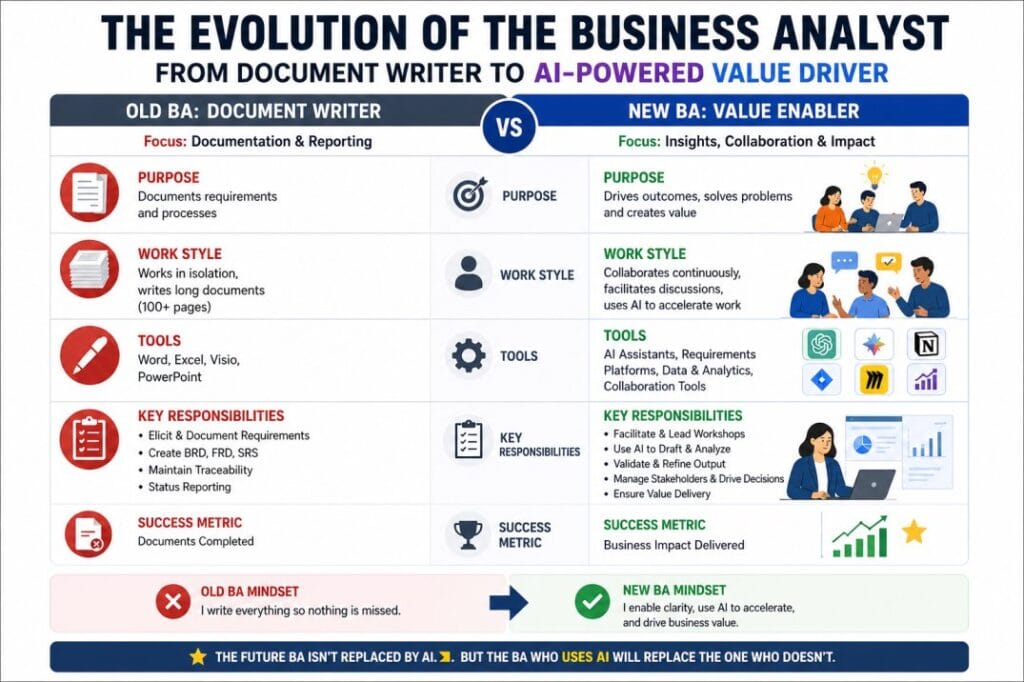
- Pure documentation BAs (AI writing tools reduce demand).
- Generic BAs with no domain specialization.
Verdict: The role is not going away, but it is evolving. The BA of 2030 will need data literacy and facilitation skills, not just document writing.
Realistic Career Advice: What Actually Leads to Success
After placing over 50 BAs into jobs, here is what separates the hired from the hopeful.
1. Your Network Is Worth More Than Your Certification
I have seen ECBA-certified candidates struggle for months while a self-taught candidate got hired because their friend referred them.
Action: Attend one IIBA local chapter meeting per month. Connect with 3 people on LinkedIn afterward. Message them: “Great meeting you. I am looking for junior BA roles. Do you have 15 minutes for an informational interview?” Most will say yes.
2. The First 90 Days in a New Job Define Your Reputation
When you finally land the role, do not try to prove how smart you are. Try to prove how helpful you are.
Do in first 90 days:
- Learn the existing processes before suggesting changes.
- Deliver every small task early.
- Ask for feedback after each deliverable.
- Build relationships with one developer and one business user.
Do NOT do:
- Propose a “better” methodology in week two.
- Complain about legacy systems.
- Say “at my last company we did it differently.”
3. Learn to Say “I Don’t Know, But I Will Find Out”
This is the most powerful phrase in a BA’s vocabulary. It builds trust. It buys you time. And it is always true.
Do not fake expertise. Stakeholders can smell bluffing.
4. Write for the Skeptic
Before sending any requirements document, imagine a tired, grumpy developer reading it. Will they understand? Will they find ambiguity?
Then imagine a busy business executive reading the same document. Is the business value clear?
If you can satisfy both, you have written well.
FAQ
Q1: Can I become a business analyst without any technical background?
A: Yes, but you need to learn basic SQL and process logic. “No technical background” does not mean “no technical learning.” A history major can become a BA. A person who refuses to learn spreadsheets cannot.
Q2: Is business analyst a good career for introverts?
A: Yes, but you must be able to run meetings and ask questions. You do not need to be the life of the party. You do need to speak up. Many excellent BAs are introverts who prepare thoroughly for every interaction.
Q3: How hard is it to get the first BA job?
A: Moderately hard. The market for junior BAs is competitive because it is seen as a good entry point. Your advantage is internal transfer (if you already work in a company) or a strong portfolio with real (not fake) examples.
Q4: What is the difference between a Business Analyst and a Data Analyst?
A: Data Analyst focuses on querying and interpreting existing data to answer questions. Business Analyst focuses on processes, requirements, and solutions (which may or may not involve data). There is overlap, but BAs do more writing and meetings; Data Analysts do more SQL and statistics.
Q5: Do I need to learn Python or R?
A: Not for a classic BA role. If you want to become a Business Intelligence Analyst or Data Analyst, then yes. But a standard BA can have a full career without Python.
Q6: Which industry is easiest to break into for beginners?
A: IT services companies (Infosys, TCS, Cognizant, etc.) hire many junior BAs. So do insurance companies and healthcare admin firms. Avoid FAANG-level tech companies as a beginner; they want experienced BAs.
Q7: How do I explain a career gap or unrelated background in interviews?
A: Directly. “I spent three years in customer service. That taught me how to listen to frustrated people and find the root cause of their problem. That is exactly what a BA does.” Translate your past into BA strengths.
Q8: Will AI replace business analysts?
A: AI will replace BAs who only write documentation. It will not replace BAs who negotiate, facilitate, and think critically. The role will shift from “documenter” to “sense-maker.” That is a good thing.
Conclusion: Your Realistic Next Step
You have now read a complete, unfiltered guide to business analyst roles and responsibilities. You know the good (stable career, good pay, variety of work) and the bad (meetings, ambiguity, being the middle person).
The difference between someone who becomes a BA and someone who only reads about it is not IQ or luck. It is execution.
Here is your exact next step for tomorrow morning:
- Open a free Lucidchart account.
- Map a process you understand well (e.g., “how to book a doctor’s appointment”).
- Write three user stories for a small improvement to that process.
- Post that diagram and those stories on LinkedIn or a BA forum. Ask for feedback.
That one action is worth more than ten courses.
You do not need to be perfect. You need to start. The industry has room for one more reliable, curious, helpful BA. Go be that person.