
Introduction
Here’s something most career guides won’t tell you devops resume example .
I’ve sat on both sides of the DevOps hiring table. As a hiring manager, I’ve rejected perfectly qualified candidates because their resumes were unreadable. As a mentor, I’ve watched talented beginners stay stuck for months because they copied the wrong templates.
The problem isn’t your skills. Most of the time, it’s how you present them.
DevOps resumes fail in predictable ways. Tool salads. No outcomes. Generic bullet points copied from LinkedIn. Recruiters spend 6–10 seconds on the first scan. If they can’t instantly see automation, infrastructure thinking, and measurable impact, you’re out.
This guide shows you exactly what works. Real examples. Real tables. Zero fluff.
What a DevOps Resume Must Prove (That Most Miss)
Before any template, understand this.
Your resume isn’t a list of technologies. It’s evidence of operational thinking.
DevOps bridges development and operations. So recruiters need to see three things within those 10 seconds:
| What They Look For | Why It Matters |
|---|---|
| Automation mindset | You don’t do manual work twice. You script it. |
| CI/CD experience | You know how code moves from commit to production safely. |
| Infrastructure as code | You treat servers and networking like application code. |
If your resume only lists “Docker, Kubernetes, Jenkins, AWS, Terraform” without showing what problem each solved, you look like every other candidate.
Who This Resume Template Is For
This template works for three types of people:
| Your Profile | What You Need |
|---|---|
| Complete beginner (no IT job yet) | Projects section must replace work experience. Focus on homelab, Cloud Resume Challenge, open source. |
| Career switcher (from developer/sysadmin/QA) | Translate past roles into DevOps language. Show automation you already did. |
| Junior DevOps with 1–2 years | Highlight specific metrics. Reduce vague statements. Show growth. |
If you’re a senior DevOps (5+ years), this template is too basic. But the principles still apply.
Skills Required: What to Actually List
Job descriptions list 20+ tools. You don’t need all of them.
Here’s the honest breakdown of what matters for a resume that gets interviews.
Core Technical Skills (Must Have)
| Category | Technologies (Learn at least one per row) |
|---|---|
| Operating System | Linux (Ubuntu, CentOS, Amazon Linux) – basics: filesystem, processes, permissions, shell |
| Scripting | Python or Bash (Go is nice, but not for junior roles) |
| CI/CD | GitHub Actions, GitLab CI, or Jenkins (pick one, learn it deeply) |
| Containers | Docker (Dockerfile, compose, volumes, networking) |
| Orchestration | Kubernetes basics (pods, deployments, services, configmaps) |
| Cloud | AWS (most common) or Azure/GCP – compute, storage, IAM, VPC |
| Infrastructure as Code | Terraform (non‑negotiable for most roles) |
| Monitoring | Prometheus + Grafana, or cloud native (CloudWatch, Azure Monitor) |
| Version Control | Git (branching, merge, rebase, conflict resolution) |
Soft Skills (List These Honestly)
Don’t just write “communication.” Show it.
| Soft Skill | How to Prove It on Your Resume |
|---|---|
| Incident management | “Participated in 3 on‑call rotations, resolved 12 production issues” |
| Documentation | “Wrote 5 runbooks for common failure scenarios” |
| Cross‑team collaboration | “Worked with 3 dev teams to standardize Dockerfiles” |
| Calm under pressure | “Helped recover database after accidental deletion – restored from backups in 22 minutes” |
Eligibility & Learning Paths (For the Resume Timeline)
Your resume will look different depending on your path. Here’s what recruiters expect.
| Path | Typical Timeline | What Goes on Resume |
|---|---|---|
| Degree + internship | 4 years + 6 months | Degree listed first, internship projects, maybe a certification |
| Self‑taught + projects | 8–14 months | No degree? Move projects above education. Show GitHub prominently. |
| Bootcamp | 4–6 months | Only if bootcamp has strong employer network. Otherwise, treat as self‑taught. |
| Internal transfer (from dev/ops) | 3–6 months upskilling | Current role, but highlight DevOps tasks you already owned. |
Realistic advice: The self‑taught path works, but your portfolio must be undeniable. One completed project is better than five half‑finished ones.
Step‑by‑Step Roadmap (From Zero to Resume‑Ready)
Use this to plan your resume timeline. Each phase builds on the last.
| Phase | Duration | Key Deliverables for Your Resume |
|---|---|---|
| Linux & scripting | 2–3 months | Bash script that automates log cleanup. Python script that calls an API. |
| Docker & CI/CD | 2 months | Dockerized web app + GitHub Actions pipeline that builds and pushes to Docker Hub. |
| Cloud & Terraform | 2–3 months | AWS free tier resources provisioned with Terraform (VPC, EC2, S3). |
| Kubernetes basics | 1–2 months | App running on Minikube or kind, with a load balancer and configmap. |
| Monitoring | 1 month | Prometheus scraping your app, Grafana dashboard screenshot in your repo. |
| Portfolio project | 1 month | Complete Cloud Resume Challenge or similar. Document everything. |
| Job applications | 2–4 months | Tailored resume, 20–30 applications weekly, interview prep. |
Total realistic timeline (part‑time): 12–18 months.
Full‑time (40 hours/week): 6–8 months.
No shortcuts. Anyone promising faster is selling a course, not a career.
Common Beginner Resume Mistakes (With Real Fixes)
I see these every week. Avoid them and you’re ahead of 70% of candidates.
| Mistake | What It Looks Like | The Fix |
|---|---|---|
| Tool salad | “Jenkins, Docker, K8s, Ansible, Chef, Puppet, Nagios, Grafana, Prometheus, AWS, GCP, Azure…” | Pick 5–7 tools you actually used. For each, write a problem you solved. |
| No numbers | “Improved deployment process” | “Reduced deployment time from 30 min to 5 min using GitHub Actions” |
| Generic experience | “Responsible for maintaining servers” | “Managed 20 Linux servers, automated patching with Ansible, saving 8 hours/month” |
| Missing GitHub link | No link, or link to empty profile | Link to profile with at least 3 pinned repos. README must explain each project. |
| Spelling errors | “Kubenetes”, “Terraformm” | Use spell check. Then ask a friend to read it. |
| Overly long summary | 6 lines of “passionate, results‑driven, synergistic…” | Delete it. Or keep to 2–3 lines with real facts. |
DevOps Resume Example (Full Table Format)
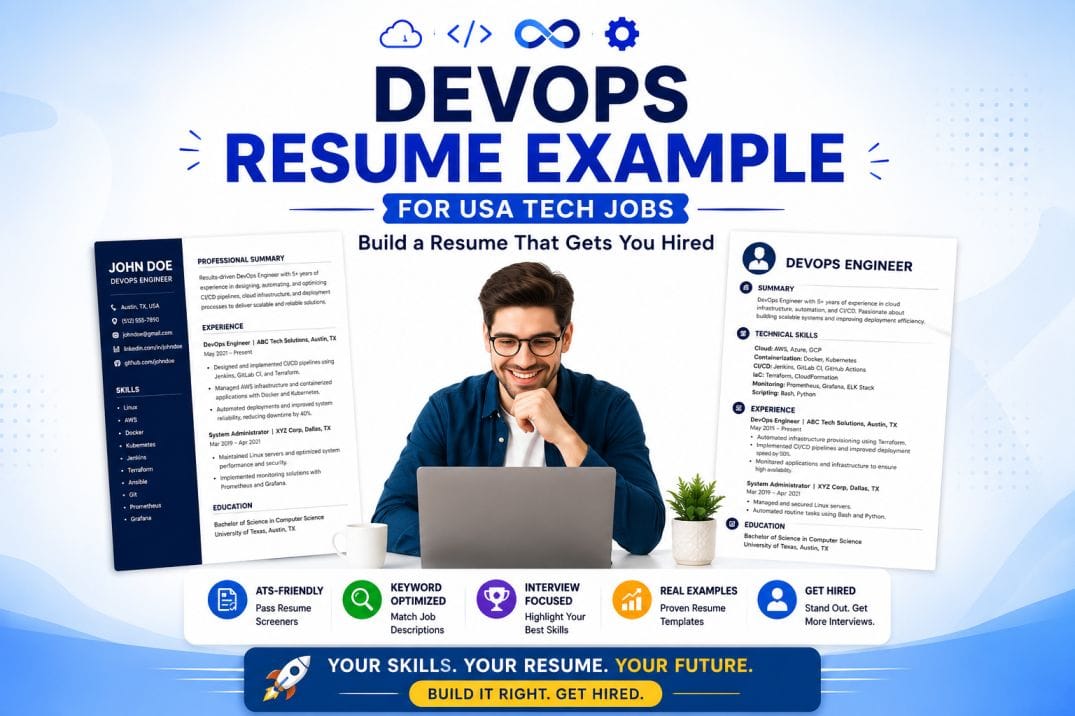
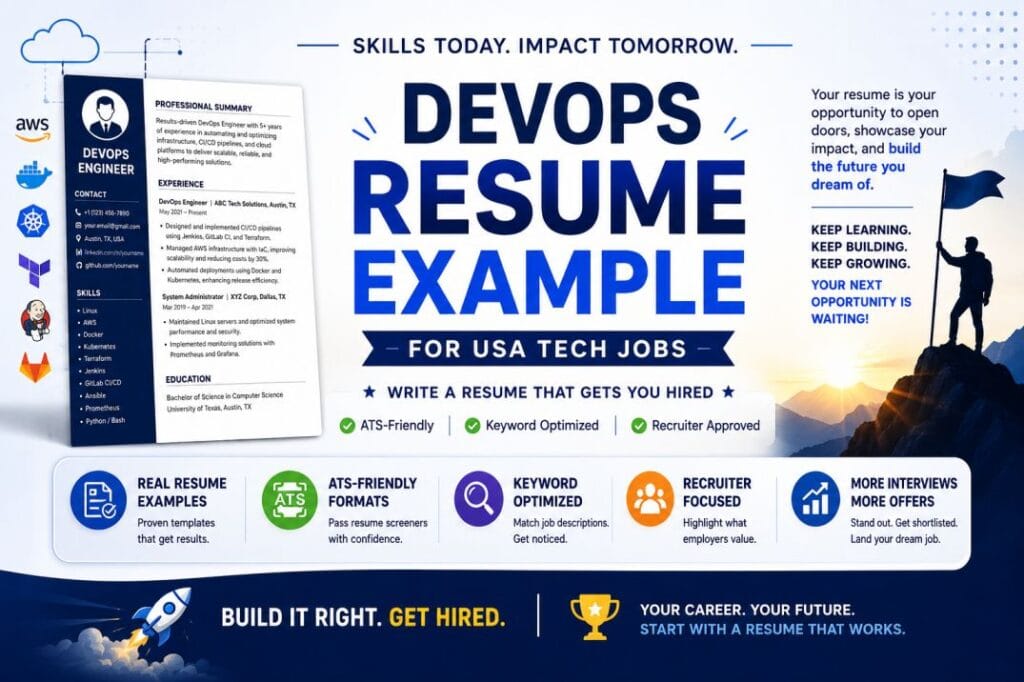
Here is a complete, realistic resume template. Use the tables as is. Replace the bracketed text with your own details.
1. Contact Header
| Field | Your Information |
|---|---|
| Name | [Your First and Last Name] |
| Phone | [Your Number] |
| [your.name@professional.com] | |
| GitHub | [github.com/yourusername] – must have recent activity |
| [linkedin.com/in/yourname] – complete profile | |
| Location | [City, State] – Open to remote / Hybrid / On‑site |
No photo. No “References available upon request.” No birthdate.
2. Professional Summary (3 lines max – keep it tight)
| Line | Content |
|---|---|
| 1 | DevOps Engineer with [X] years of experience automating cloud infrastructure and CI/CD pipelines. |
| 2 | Reduced deployment failures by [~40%] through infrastructure‑as‑code and automated testing. |
| 3 | Seeking to bring automation‑first thinking to [Target Company Name]’s platform team. |
Pro tip: Customize line 3 for every application. Mention their tech stack if you know it.
3. Technical Skills (Grouped by Purpose)
| Category | Technologies |
|---|---|
| Cloud | AWS (EC2, S3, IAM, VPC, RDS) – working towards Solutions Architect |
| IaC | Terraform (provisioned 10+ resources), CloudFormation (basic) |
| CI/CD | GitHub Actions (primary), GitLab CI, Jenkins (legacy support) |
| Containers | Docker (Dockerfile, compose, multi‑stage builds), Kubernetes (K3s, EKS basics) |
| Code | Python (automation scripts), Bash (system tasks), Go (learning) |
| Monitoring | Prometheus, Grafana, CloudWatch alarms |
Note: Only list “learning” if you can answer basic questions in an interview.
4. Work Experience (Outcome‑focused – one table per role)
Current Role: DevOps Engineer
| Company | [Current Company Name] | Duration | [Month Year] – Present |
|---|---|---|---|
| Achievement 1 | Migrated 15 microservices from manual EC2 deployments to ECS with Terraform, reducing deployment time from 45 minutes to 8 minutes. | ||
| Achievement 2 | Built CI/CD pipeline in GitHub Actions that runs tests, builds images, and deploys to staging on every PR – caught 23 integration issues before production last quarter. | ||
| Achievement 3 | Reduced PagerDuty alerts by 60% by adding proper health checks and auto‑recovery scripts for common failure modes. | ||
| Achievement 4 | Wrote runbooks for 5 common failure scenarios, cutting mean‑time‑to‑recovery from 45 to 18 minutes. |
Previous Role: Systems Administrator
| Company | [Previous Company Name] | Duration | [Month Year] – [Month Year] |
|---|---|---|---|
| Achievement 1 | Managed 50+ Linux servers, automated user provisioning with Ansible (saved 10 hours weekly). | ||
| Achievement 2 | Led migration from on‑premise to AWS, documented all steps for compliance audit – passed with zero findings. | ||
| Achievement 3 | Set up Prometheus monitoring for critical services – first time the team had visibility into CPU/memory usage trends. |
If you have no work experience: Replace this section with “Projects” (see below). Do not invent fake jobs.
5. Projects (For beginners or career switchers)
| Project Name | Technologies | What You Did | Link |
|---|---|---|---|
| Cloud Resume Challenge | AWS S3, CloudFront, Lambda, DynamoDB, Terraform, GitHub Actions | Deployed static resume website with visitor counter. Infrastructure as code. CI/CD on every git push. | [GitHub Repo Link] |
| Homelab Kubernetes Cluster | K3s, Raspberry Pi 4, Prometheus, Grafana | 3‑node cluster running Pi‑hole, personal blog, and monitoring stack. Documented full setup. | [GitHub Repo Link] |
| Dockerized Flask App with CI | Python, Docker, GitHub Actions, Docker Hub | Built simple web app, Dockerfile, pipeline that tests, builds, and pushes image on push to main. | [GitHub Repo Link] |
Rule: Every project must have a README that explains the problem, your solution, and how to run it. Screenshots help.
6. Certifications (Honest placement)
| Certification | Status | Expected/Owned Date |
|---|---|---|
| AWS Solutions Architect Associate | Completed | March 2024 |
| Certified Kubernetes Administrator (CKA) | Scheduled | September 2024 |
| HashiCorp Terraform Associate | Studying | December 2024 (target) |
Do not lie about certifications. Companies verify. “In progress” is fine if you have a scheduled exam date.
7. Education (Keep brief)
| Degree/Course | Institution | Year |
|---|---|---|
| B.Tech in Computer Science | [University Name] | 2021 |
| OR: Self‑taught (no degree) | Online: Linux Journey, KodeKloud, Adrian Cantrill | 2022–2024 |
If you have no degree, leave this section small and let your projects speak.
Salary & Job Market Reality (So You Set Expectations)
Here are real numbers from 2024–2025. Not inflated blog figures.
India (Bengaluru, Hyderabad, Pune, NCR, remote)
| Level | Experience | Salary Range (INR per annum) |
|---|---|---|
| Junior / Trainee | 0–2 years | 5–9 LPA |
| DevOps Engineer | 2–5 years | 10–20 LPA |
| Senior DevOps | 5–8 years | 22–35 LPA |
| Lead / Architect | 8+ years | 40–70 LPA |
United States / Europe (remote or local)
| Level | Experience | Salary Range (USD) |
|---|---|---|
| Junior | 0–2 years | 70k–95k |
| Mid‑level | 2–5 years | 100k–140k |
| Senior | 5–8 years | 140k–185k |
| Staff / Principal | 8+ years | 180k–250k+ |
Reality check:
- Remote roles from India pay less than US local rates (typically 30–50% less).
- European salaries are lower than US but include better benefits and more vacation.
- The market for juniors is competitive. After 2 years of experience, recruiters start reaching out.
Realistic Career Advice (From Someone Who’s Been There)
Let me give you the advice I wish I had.
What Actually Matters for Getting Hired
| Priority | Action |
|---|---|
| #1 | A GitHub repo with one complete, documented project that solves a real problem. |
| #2 | Ability to explain your infrastructure decisions out loud (record yourself practicing). |
| #3 | Basic Linux + scripting skills that don’t fall apart in a 15‑minute live exercise. |
| #4 | Certifications (nice to have, but never the deciding factor). |
Time Investment (Be Honest With Yourself)
- Full‑time job seeker (40 hours/week): 6–8 months to reach interview readiness.
- Part‑time (evenings + weekends, 15–20 hours/week): 12–18 months.
- Casual learner (5 hours/week): Over 2 years – not recommended for career switching.
Long‑Term Sustainability
DevOps can burn you out. On‑call rotations. Production incidents. Constant tool changes.
The engineers who last are the ones who:
- Automate everything they do twice.
- Document their work (future you will thank you).
- Set boundaries around on‑call hours.
- Say “no” to learning the tenth monitoring tool when they haven’t mastered the first.
It’s a good career. Challenging, well‑paid, and intellectually interesting. But it rewards depth, not hype.
FAQ
Do I need a degree for DevOps?
No. But large companies (Amazon, Microsoft, banks) often filter by degree. Without one, you need a stronger portfolio and may need to start at smaller companies. After 2–3 years of experience, the degree matters much less.
Which cloud provider should I learn?
AWS has the most jobs and learning resources. Learn AWS first. Skills transfer partially to Azure/GCP.
Can I get a DevOps job with no experience?
Yes, but your projects become your experience. Complete the Cloud Resume Challenge. Run a homelab. Contribute to an open source infrastructure project. These signal that you can do the work without the job title.
How important is Kubernetes for a junior?
Learn the basics (pods, deployments, services, configmaps). You don’t need to be a CKA. Many junior roles use managed Kubernetes (EKS, GKE, AKS) with higher‑level abstractions.
What’s the hardest part of the DevOps interview?
Live troubleshooting. You’ll get a scenario like “Our deployment is failing at 2 AM. Walk me through your debugging process.” Practice these out loud with a friend or record yourself.
Is DevOps dying because of platform engineering?
No. Platform engineering is a specialization within DevOps. If anything, it creates senior roles for experienced DevOps engineers who build internal tools. The fundamentals (automation, CI/CD, IaC) remain essential.
How do I show my DevOps skills on a resume with no job?
Your projects section. For each project, write: “Built [something] using [tools] that solves [problem].” Example: “Built a CI/CD pipeline using GitHub Actions that deploys a containerized app to AWS on every commit, reducing manual steps from 15 minutes to zero.”
Conclusion
Let me be direct.
This resume template will not get you a job by itself. It only gets you to the interview. The real work is learning to think operationally, building things that don’t break, and staying calm when they do.
But if you follow the roadmap – build real projects, document your work, avoid the common mistakes – you will get interviews. I’ve seen it happen for college graduates, career switchers, and self‑taught learners.
Start today.
Open your terminal. Write one small script. Put it on GitHub. Repeat tomorrow.
That messy, frustrating, inconsistent process is what actually teaches DevOps. No resume template can fake that.
Good luck.