
Introduction
If you’re searching for a java developer roadmap that actually tells you what to learn first and what to skip, you’ve probably noticed a problem.
Most roadmaps are either:
- Too vague (“learn Java, then Spring, then get job”)
- Too overwhelming (20+ technologies listed with no priority)
- Written by someone who hasn’t been in the industry recently
Here’s something most online guides won’t tell you.
When I first started mentoring beginners, almost everyone asked the same question: “How long until I can actually build real things with Java?”
They’d completed a course. Maybe two. Still felt lost.
The problem isn’t Java itself. The problem is the overwhelming amount of information out there. Spring Boot, Hibernate, Maven, microservices, cloud – it’s easy to spend months jumping between topics without building anything useful.
This roadmap cuts through that noise.
I’ve seen what actually works for beginners who land jobs. And I’ve seen what wastes time. Let me show you the difference.
What Exactly Does a Java Developer Do?
Let me be practical here.
A Java developer builds backend systems. When you log into a banking app, book a flight, or process an online payment – Java is often running the show behind the scenes.
You’re not making pretty buttons or animations. You’re writing code that handles data, processes requests, talks to databases, and keeps everything secure and fast.
Real day-to-day work includes:
- Writing APIs that mobile apps or websites talk to
- Building logic for things like “calculate this user’s cart total with discounts”
- Connecting applications to databases
- Fixing performance bottlenecks
- Debugging why something broke at 2 AM (yes, this happens)
The work is logical. If you enjoy solving puzzles and building systems that actually do things, you’ll probably like it.
Who Should Choose This Career? (And Who Shouldn’t)
This might be for you if:
- You like structured, logical problem-solving
- You’re patient with details (missing a semicolon breaks everything)
- You don’t mind reading documentation
- You prefer stability over chasing every new tech trend
You might struggle if:
- You want instant visual feedback (try frontend or design instead)
- You hate debugging
- You expect to build Instagram in three months
- You want minimal learning and maximum shortcuts
Here’s an honest observation: Java isn’t glamorous. You won’t impress people at parties by saying you write Java. But it pays well, it’s everywhere, and experienced Java developers are consistently in demand.
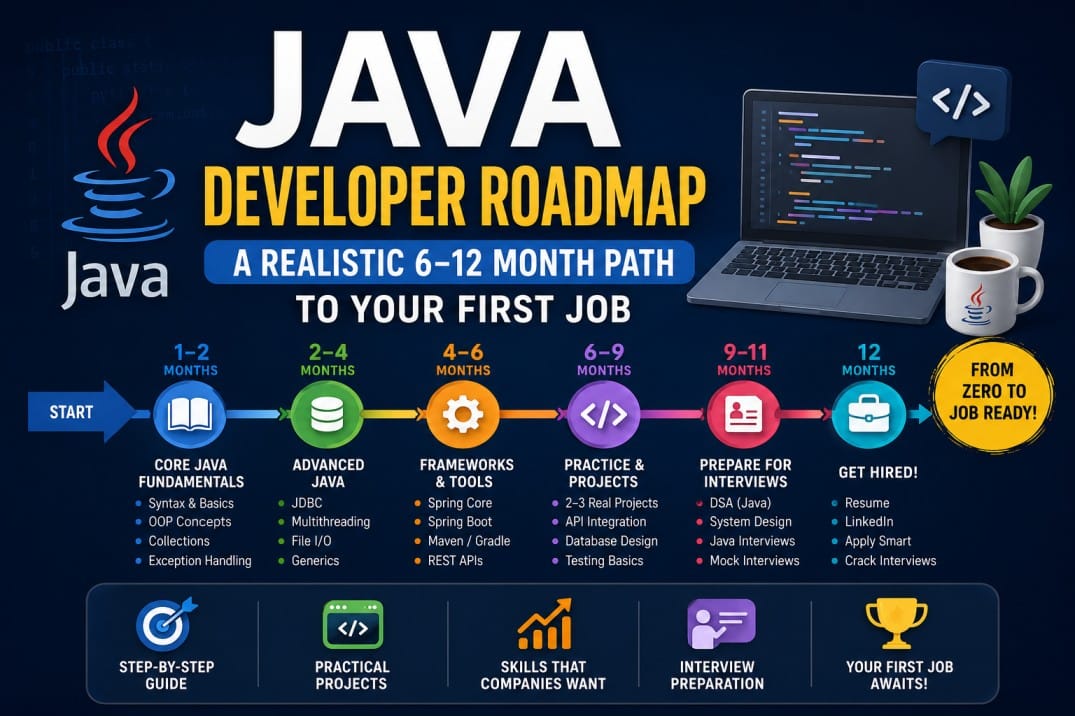
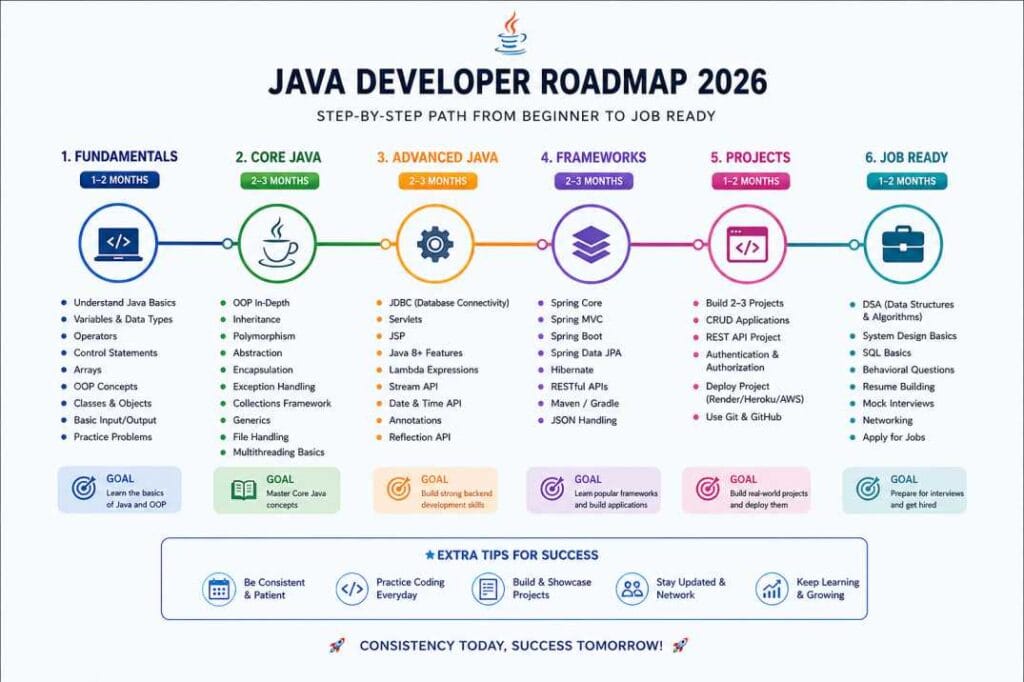
Java Developer Roadmap: Step-by-Step Breakdown
Let me be clear about timeframes. Ignore anyone promising “become a Java developer in 30 days.”
Month 1–2: Core Java Foundation
Learn syntax, variables, loops, conditionals. Then move to OOP – classes, objects, inheritance, polymorphism. Build tiny programs. A calculator. A simple banking system (just console input/output).
Realistic outcome: You can write small programs under 200 lines.
Month 2–3: Data Structures & Problem Solving
Arrays, ArrayLists, HashMaps. Basic algorithms. Practice on platforms like LeetCode (easy problems only at this stage).
Why this matters: Interviews test this. More importantly, you need these skills to write efficient code.
Month 3–4: Database & JDBC
Learn SQL. Practice with PostgreSQL or MySQL. Understand CRUD operations. Learn to connect Java to databases using JDBC.
Build something simple – a contact management app that saves to a database.
Month 4–5: Build Tools & Git
Learn Maven. Understand pom.xml. Practice Git – commits, branches, pull requests. Create a GitHub account and push everything.
Month 5–7: Spring Boot & REST APIs
Now you’re ready. Learn Spring Boot fundamentals. Build REST endpoints. Connect to databases using Spring Data JPA. Understand dependency injection.
Build a small project – maybe a task manager API.
Month 7–9: Portfolio Projects
Build 2–3 complete projects. Not tutorial projects. Your own ideas.
Examples:
- URL shortener service
- Blog platform backend
- Expense tracker with user authentication
Put these on GitHub with clear README files.
Month 9–12: Interview Preparation
Practice Java interview questions daily. Learn common Spring questions. Prepare behavioral answers. Apply to jobs while continuing to build.
Skills Required: From Zero to Job-Ready
Let me break this into what you actually need vs. what courses try to sell you.
Core Java (Non-negotiable)
| Skill | Why It Matters |
|---|---|
| OOP concepts | Every Java job interview asks this |
| Collections framework | You’ll use this daily |
| Exception handling | Real code breaks constantly |
| Multithreading basics | Important for performance |
| Lambda expressions | Modern Java requires this |
| Stream API | Makes data processing cleaner |
Don’t skip OOP. I’ve seen candidates who memorized Spring Boot but couldn’t explain polymorphism. They didn’t get hired.
Essential Tools
- Git – You’ll use this every single day on any real team
- Maven or Gradle – Build tools. Learn Maven first. It’s more common in enterprise.
- REST APIs – How your backend talks to the world
- SQL – Java without databases is useless. Learn JOINs properly.
The Spring Framework Reality Check
Spring Boot dominates Java jobs. Check any job board – most Java roles ask for Spring experience.
But here’s what nobody tells beginners: Don’t start with Spring.
Learn Core Java first. Build a few small console applications. Add a database connection. Then learn Spring. Otherwise, you’ll be copy-pasting code without understanding what’s happening under the hood.
Soft Skills That Actually Matter
- Reading other people’s code – Most of your job is maintaining existing systems
- Asking good questions – Knowing what to Google is a real skill
- Breaking down problems – Before writing code, think through the logic
Eligibility & Learning Paths
Do you need a degree?
Not necessarily. But let me be honest – a CS degree helps with interviews at large companies. Many still filter resumes.
That said, I’ve worked with self-taught developers who are brilliant. The difference? They built real projects and could talk about them intelligently.
Your options:
- Formal degree (B.Tech/BCA) – Best for long-term career growth and visa purposes
- Bootcamps – Faster but expensive. Quality varies wildly.
- Self-taught – Slowest but most flexible. Requires serious discipline.
The path matters less than your portfolio. Show me working applications, not certificates.
Best Learning Resources (Tested, Not Just Listed)
Free Resources (Start Here)
- Java Programming Masterclass (Tim Buchalka) – Often on sale. Covers Core Java thoroughly.
- Bro Code YouTube channel – Great for visual learners
- Code with Mosh – Clear explanations
- W3Schools Java Tutorial – Quick reference
- GeeksforGeeks – When you need examples
Paid Resources (Worth the Money)
- Spring Start Here (book) – Best Spring resource for beginners. Buy this.
- Effective Java (Joshua Bloch) – Intermediate level. Read after 6 months.
- Head First Java – If you find textbooks boring, this works.
Practice Platforms
- HackerRank Java track – Structured exercises
- LeetCode (easy problems) – For interview prep
- Codewars – Fun kata-style challenges
Communities
- r/learnjava on Reddit
- Java Discord servers
- Stack Overflow (learn to search before asking)
Common Beginner Mistakes (Learn From Others)
I’ve seen these patterns repeat for years.
1. Learning every Java feature before building anything
You don’t need to memorize the entire standard library. Learn enough to build something, then learn as you go.
2. Jumping straight to Spring Boot
This is the #1 mistake. You’ll end up with code you don’t understand. When something breaks (and it will), you won’t know how to fix it.
3. Copy-pasting without understanding
Tutorial code runs. That’s fine for learning syntax. But rewrite it yourself. Change variable names. Break it on purpose. See what happens.
4. Ignoring Git
I’ve interviewed candidates with great portfolios who couldn’t explain a merge conflict. That’s a red flag for team collaboration.
5. Building only calculator and to-do apps
Everyone builds these. Build something slightly different. A habit tracker. A simple inventory system. Stand out.
6. Expecting a job after one course
You need projects. Real ones. Courses teach syntax. Projects teach problem-solving. Employers want the second one.
Java Developer Salary, Jobs & Future Scope
Let me give you realistic numbers. These vary significantly by location and company.
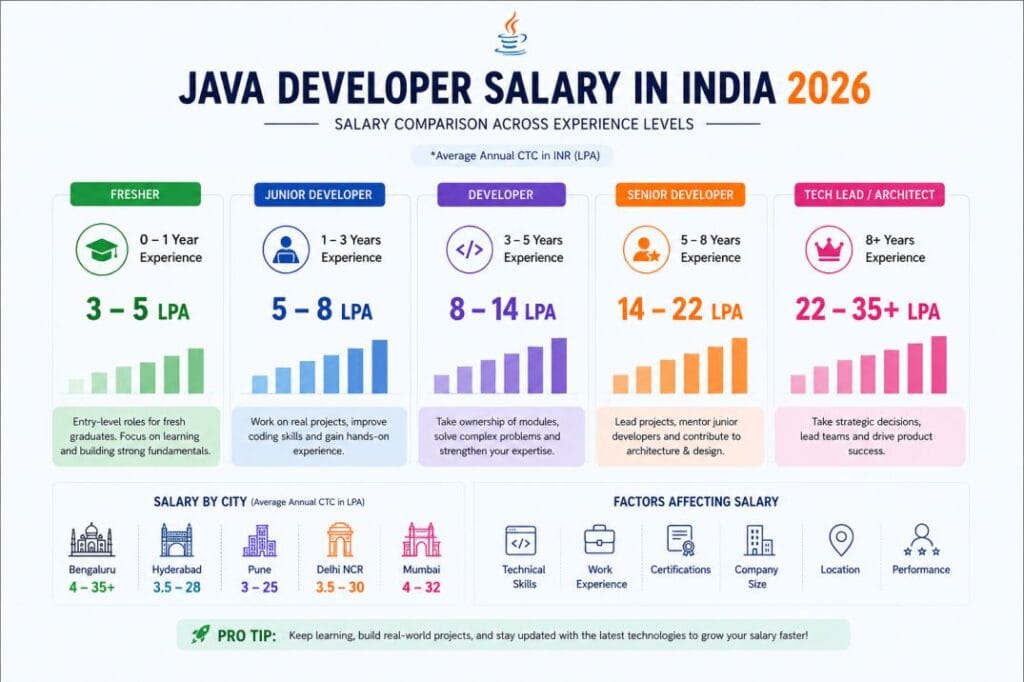
India (approximate)
| Level | Experience | Annual Salary Range |
|---|---|---|
| Fresher | 0-1 year | ₹3-6 LPA |
| Junior | 1-3 years | ₹5-10 LPA |
| Mid-level | 3-6 years | ₹10-18 LPA |
| Senior | 6+ years | ₹18-35 LPA+ |
US / Europe (approximate)
| Level | Experience | Annual Salary Range |
|---|---|---|
| Entry | 0-2 years | $65k-85k |
| Mid-level | 3-5 years | $90k-130k |
| Senior | 5+ years | $130k-180k+ |
Remote opportunities: Growing but competitive. US companies hiring remote Java developers often expect strong English and overlapping time zones.
Freelance possibilities: Less common for beginners. Most Java freelancing requires proven experience. Start with full-time employment first.
Job market reality: Java isn’t going anywhere. Banking, insurance, healthcare, e-commerce – massive systems run on Java. But entry-level is competitive. Your portfolio matters more than your resume.
Realistic Career Advice (What Nobody Tells You)
Competition level at entry: High. Many applicants. Stand out with projects that actually work.
Time investment: 6-12 months of consistent effort. “Consistent” means 10-15 hours weekly minimum. Less than that? Expect 18+ months.
What actually matters for success:
- Building things, not just watching tutorials
- Understanding why code works, not just that it works
- Learning to debug effectively (print statements are fine, don’t overcomplicate this)
Long-term sustainability: Java developers have good careers. The work stays challenging. You’ll constantly learn new tools while the core language remains stable.
Honest expectation: Your first job will be harder than you expect. Legacy code. Unclear requirements. Tight deadlines. Everyone goes through this. Ask questions, take notes, improve slowly.
Do you need to learn every framework? No. Spring Boot + Hibernate covers most enterprise jobs. Learn others when you need them.
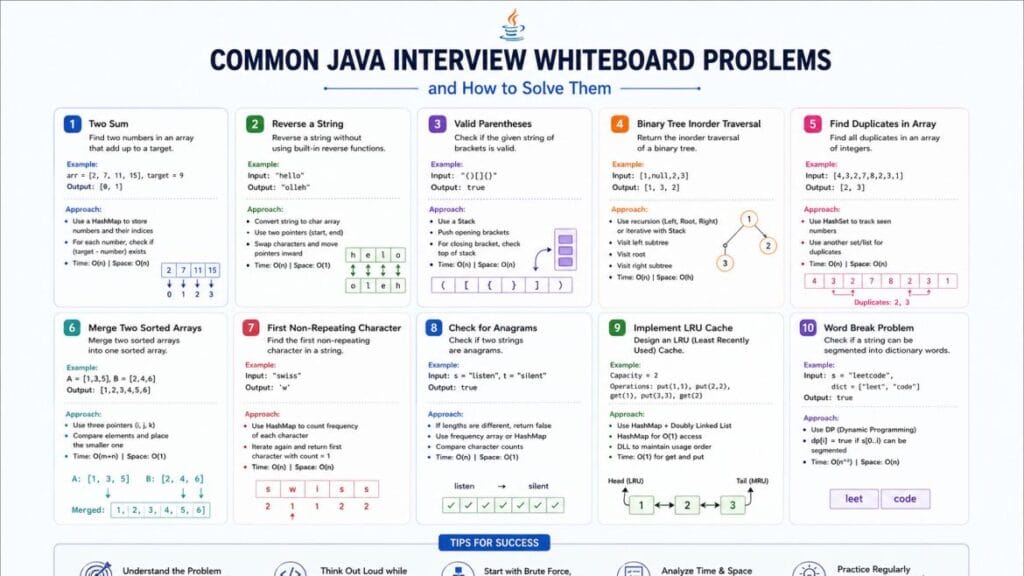
Java Developer Interview Questions (What They Actually Ask)
Based on real interviews I’ve seen candidates go through:
Core Java (Expect these):
- Explain polymorphism with an example
- Difference between ArrayList and LinkedList
- How does HashMap work internally?
- What’s the difference between checked and unchecked exceptions?
Spring Boot (Common questions):
- What’s dependency injection and why use it?
- Difference between
@Component,@Service,@Repository - How does Spring Boot auto-configuration work?
SQL (Surprisingly common for Java roles):
- Write a JOIN query for two tables
- Difference between INNER and LEFT JOIN
- What’s an index and when would you create one?
Problem-solving (Junior level):
- Reverse a string without using built-in reverse methods
- Find duplicate elements in an array
- Check if a string is a palindrome
Practice these aloud. Recording yourself helps.
FAQ
Is Java still worth learning in 2026?
Yes. Java powers most large enterprise systems. Banking, trading platforms, insurance, healthcare – these aren’t rewriting everything for Python or Go. Job market remains strong for competent developers.
Java vs Python – which should I learn first?
Depends on your goal. Python is easier to start and great for data work. Java teaches stricter OOP and is more common in traditional software engineering jobs. Both are fine. Pick based on jobs in your area.
How long to become job-ready using this java developer roadmap?
6 months if you can study full-time (30+ hours/week). 12 months for part-time learners (10-15 hours/week). Anyone promising faster is selling something.
Do I need to learn data structures and algorithms?
For interviews at product companies – yes. For service-based companies or freelancing – less emphasis but still helpful. At minimum, understand arrays, hash maps, recursion, and basic sorting.
What projects should I build for my portfolio?
Build something you’d actually use. A budget tracker. A reading list manager. A simple inventory system for a local business you know. Original projects beat tutorial projects every time.
Can I get a Java job without a degree?
Yes, but it’s harder. Your portfolio needs to compensate. Expect more rejections. Once you have 2+ years of experience, the degree matters much less.
Is Spring Boot mandatory?
For most Java backend jobs – yes. There are exceptions (Android, some legacy systems), but Spring Boot dominates. Learn it.
What’s the biggest mistake self-taught learners make?
Not finishing projects. Starting something, getting stuck, then starting something new. Finish one complete project before moving on. “Finished” means working code you could show someone.
One thought on “Java Developer Roadmap: A Realistic 6–12 Month Path to Your First Job”
Comments are closed.