
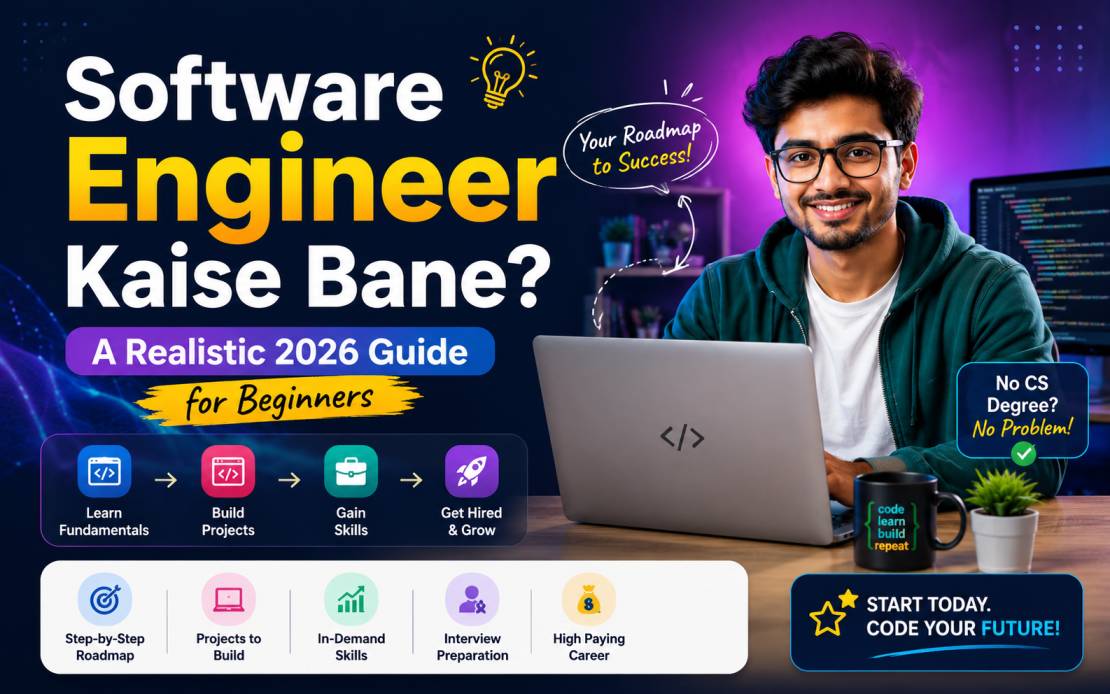
If you’ve typed “software engineer kaise bane” into Google, you’ve already seen the usual answers:
Learn coding. Do a course. Get a job.
But that’s like saying “how to cook biryani” and answering “buy rice and masala.” Technically true. Practically useless.
Let me give you the answer that actually helps.
I’ve seen fresh graduates from small-town colleges crack ₹12 LPA jobs in 12 months. I’ve also seen CS degree holders with great marks struggle for two years to land a ₹15k internship.
The difference? Not intelligence. It’s knowing the real answer to “software engineer kaise bane” — not the textbook version.
In this guide, I’ll walk you through:
- What software engineers actually do all day (spoiler: not just coding)
- Who should and should not choose this path
- The exact skills you need, from beginner to job-ready
- Real software engineer salary in India (fresher to senior)
- What an associate software engineer does and how much they earn
- A month-by-month roadmap that works for self-taught learners and college students alike
Let’s start with the most important question.
Software Engineer Kaise Bane? First, Understand What the Job Really Is
Most beginners think: software engineer = writing code all day.
Here’s the truth. Coding is maybe 40% of the job. The rest is:
- Reading and debugging other people’s code
- Figuring out why the server crashed at 2 AM
- Discussing requirements with product managers
- Writing documentation (yes, really)
- Testing your own assumptions
In simple terms, a software engineer builds and maintains digital products — from UPI apps to railway booking systems. You take a problem (“users need to pay bills online”) and turn it into reliable software.
But here’s what nobody tells you when you search “software engineer kaise bane”:
- You will feel stupid regularly. That’s normal.
- You’ll break things before you fix them.
- You’ll spend hours reading documentation, not writing code.
The good news? When it finally works, the feeling is genuinely addictive.
Who Should Actually Choose This Career? (Be Honest Here)
Not everyone who can learn to code should become a software engineer.
You will likely enjoy this if:
- You have patience for puzzles that take hours to solve
- You don’t mind being wrong and trying again
- You can focus deeply for 2-3 hours at a stretch
- You prefer clarity: you like knowing why something works
You will struggle if:
- You need constant motivation from others
- You hate continuous learning (tech changes every year)
- You expect step-by-step instructions for every problem — real work has no tutorial
- You’re only here because “IT pays well”
I’ve mentored history graduates who became excellent engineers. I’ve also seen toppers quit because they hated the loneliness of debugging. Be honest now. It saves years of frustration.
Skills You Actually Need (Not a 50-Item Checklist)
Beginners often ask: “Which language should I learn first?”
Wrong question. Learn problem-solving first. Languages are just tools.
Technical Skills (Start Here)
| Skill Level | What You Must Know |
|---|---|
| Beginner | Python or JavaScript, loops, conditionals, arrays, basic Git, terminal commands |
| Intermediate | OOP, SQL (mandatory), APIs, one framework (React, Django, or Spring Boot) |
| Job-Ready | Version control workflows, testing, basic cloud deployment (AWS/Azure), debugging production issues |
Soft Skills (The Real Filter for Jobs)
You can write perfect code and still not get hired if you cannot:
- Explain why you chose one approach over another
- Ask clarifying questions before starting work
- Estimate how long a task will take (realistically)
- Take feedback without getting defensive
In interviews, this matters as much as coding.
Eligibility & Learning Paths: Degree vs Self-Taught vs Bootcamp
When people ask “software engineer kaise bane”, they often worry about degrees.
Here’s the Indian reality.
Option 1: B.Tech/BE in CS/IT
Best for: Those with 3-4 years and family pressure for a degree.
Reality: A tier-1/2 degree opens doors. A tier-3 degree just checks a box. What matters is what you build outside syllabus.
Hidden truth: Some hiring managers now prefer non-CS graduates because they have better practical skills. But HR filters sometimes cut off non-degree holders. If you can get any bachelor’s (BCA, BSc CS, even BCom with coding skills), do it alongside self-learning.
Option 2: Self-Taught (No Degree)
Works for: People with exceptional projects, open source contributions, or freelancing work.
Does not work for: Government jobs, WITCH companies (Wipro, Infosys, TCS, Cognite, HCL), or visas for abroad.
Option 3: Bootcamps
Reality: Some are excellent. Most are overpriced tutorial collections. Research deeply before paying ₹1-3 lakhs.
My honest take: Use free resources first. If you complete 3-4 months of self-study and still feel stuck, then consider a bootcamp for structure.
Step-by-Step Roadmap to Become a Software Engineer (6-18 Months)
This is the practical answer to “software engineer kaise bane” — month by month.
Months 1-3: Fundamentals
- Pick Python or JavaScript. Don’t switch.
- Learn variables, loops, functions, conditionals.
- Solve 2-3 small problems daily on HackerRank.
- Goal: Build a simple calculator or to-do list in the terminal.
Months 4-6: Data Structures & Algorithms (DSA)
- Arrays, strings, hash maps, stacks, queues, recursion.
- Basic sorting and searching.
- Solve ~100 problems across these topics.
- Goal: Solve medium-level problems in under 40 minutes.
Months 7-9: Databases & Backend Basics
- Learn SQL (joins, aggregations, indexing basics). This alone clears many junior interviews.
- Build a small project (student record system, blog backend).
- Learn how HTTP works (status codes, request-response).
Months 10-12: One Framework & One Full Project
- Python → Django or FastAPI. JavaScript → React + Node.js.
- Build one complete project: expense tracker with login, movie recommender, job board.
- Critical: Deploy it on Render or Vercel. A live link is worth 100x “I know React.”
Months 13-15: Interview Preparation
- Solve 150-200 LeetCode problems (500 is overkill for most Indian companies).
- Practice explaining your projects out loud. Record yourself.
- Apply to 5-10 companies daily. Track everything.
Months 16-18: First Job or Internship
- Target startups and service-based companies first.
- After 12-18 months, switch to better roles.
Best Learning Resources (That Actually Work)

Free first. Always.
| Type | Resource | Why It Works |
|---|---|---|
| Python | CS50P (Harvard free) | Teaches programming, not just syntax |
| DSA | takeUforward | Best free resource for Indian interview patterns |
| Web Dev | The Odin Project | Project-based, forces you to build |
| Practice | HackerRank (easy), LeetCode (medium+) | Start easy, build confidence |
Paid (only if budget allows): Udemy courses during sales (₹400-500). AlgoExpert for product company prep.
Avoid YouTube tutorial hell. After every video, close it and build something small.
Common Beginner Mistakes (I See These Daily)
- Learning too many languages – Deep knowledge of one stack beats shallow knowledge of five.
- Ignoring Git – Not knowing Git in 2026 is like being a writer who can’t save a file.
- Copy-pasting without understanding – If you copy it, be able to rewrite it from memory.
- Building projects nobody uses – A tool your friends actually use is infinitely more impressive.
Salary, Jobs & Future Scope (Real Numbers)
When people search “software engineer salary” or “software engineer salary in india”, they get exaggerated figures. Here’s the truth.
Entry-Level (0-2 years) – including Associate Software Engineer
| Role | Salary Range (India) |
|---|---|
| Associate Software Engineer (small startup) | ₹3 – 5 LPA |
| Associate Software Engineer (service company like Infosys/TCS) | ₹3.5 – 4.5 LPA |
| Software Engineer (product startup) | ₹6 – 9 LPA |
| Software Engineer (mid-level product company) | ₹8 – 12 LPA |
| Remote freelancing (international) | ₹15-25 LPA (inconsistent) |
Reality check for “associate software engineer”: This is the most common entry-level title. Most freshers start between ₹3-5 LPA. The ₹25 LPA fresher jobs exist, but less than 1% get them. Aim realistic, then grow.
Mid-Level (2-5 years)
- Service companies: ₹6-10 LPA
- Product companies: ₹12-22 LPA
- Remote US/EU contracts: ₹30-50 LPA
Senior (5+ years)
- Team lead/Architect: ₹25-45 LPA in India
- Freelance agency owner: ₹30-80 LPA possible
Future Scope (Next 5 Years)
AI tools will not replace engineers. But engineers using AI will replace those who don’t. Specialize in backend systems, DevOps, cloud, or mobile development. Avoid over-saturated areas like basic frontend (React has too many freshers now).
Realistic Career Advice (What I Wish Someone Told Me)
- Competition is real – For every junior role, 500-1000 applications come in. But 80% cannot reverse a string or explain a SQL join. Be in the top 20%.
- Rejection is normal – My first 40 applications got no response. The 41st led to a ₹12k/month internship. Two years later, ₹15 LPA.
- What actually matters: Consistency (2 hours daily), projects you can talk about, communication skills, real networking (helping others, not spamming LinkedIn).
- Work-life balance: Entry-level service companies can demand 50-60 hour weeks. Product companies are better. Freelancing gives flexibility but unpredictable income.
FAQ
Can I become a software engineer without a degree in India?
Yes, but harder. Target startups and freelancing first. After 2-3 years of experience, degrees matter much less. But government jobs and large service companies will reject you without a degree.
Which language should I learn first: Python or Java?
Python for faster job readiness (6-9 months). Java for long-term career in banking or large enterprises. Start with Python if unsure.
How many hours daily?
2-3 focused hours daily for 12 months beats 8 hours for 3 months (then quitting). Consistency wins.
What is the salary of an associate software engineer in India realistically?
₹3.5 – 5 LPA for most freshers. ₹6-9 LPA in good product startups. Above ₹12 LPA as a fresher is exceptional and requires strong DSA and projects.
Is software engineering still a good career in 2026?
Yes, but for problem-solvers, not for people who just want an easy paycheck. If you genuinely enjoy building and debugging, demand remains strong.
Conclusion: Your Real Next Step
You’ve read the guide. You now know the real answer to “software engineer kaise bane”.
But knowing and doing are different.
Here’s your actual next step – not another bookmark, not another course purchase:
- Pick one language (Python or JavaScript). Install it right now.
- Write your first program in the next 30 minutes (not watching – typing).
- Do this again tomorrow. And the day after.
In three months, you’ll either know this path is for you, or you’ll know it isn’t. Both are wins.
The market rewards builders, not collectors. Start small. Stay consistent. And when you get stuck – you will – remember: every senior engineer was once a beginner who didn’t quit during the frustrating parts.
Now go write some code. That’s how you actually become a software engineer.