
Let Me Show You the Numbers First
Because that’s what you came for.
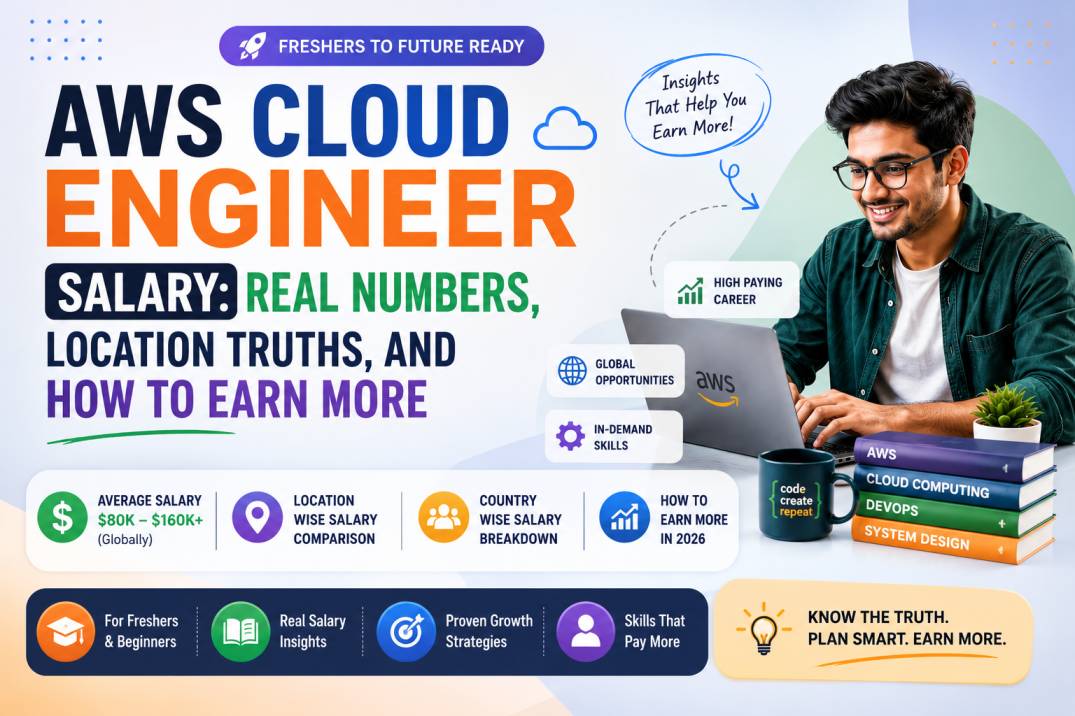
You’ve been searching “AWS cloud engineer salary” and seeing wildly different figures. Some websites say freshers make ₹12 LPA. Others say ₹3.5 LPA. Both are published by “experts.”
Here’s what actually happens.
These numbers come from real offer letters I’ve reviewed over the past six years — not job board averages that mix support roles with engineering roles.
| Experience | Salary Range | Monthly Take-Home (approx) |
|---|---|---|
| Fresher (0-1 year) | ₹3.5 – 6.5 LPA | ₹28,000 – ₹50,000 |
| Junior (1-3 years) | ₹6 – 12 LPA | ₹45,000 – ₹85,000 |
| Mid-level (3-6 years) | ₹12 – 22 LPA | ₹85,000 – ₹1,50,000 |
| Senior (6-9 years) | ₹22 – 35 LPA | ₹1,50,000 – ₹2,40,000 |
| Lead / Architect (9+ years) | ₹35 – 60+ LPA | ₹2,40,000 – ₹4,50,000+ |
United States – Annual Salary (USD)
| Experience | Salary Range |
|---|---|
| Fresher / Entry | 70,000–95,000 |
| Junior (1-3 years) | 95,000–130,000 |
| Mid-level (3-6 years) | 130,000–165,000 |
| Senior (6-9 years) | 165,000–210,000 |
| Lead / Architect (9+ years) | 200,000–280,000+ |
A quick word on US numbers: San Francisco, New York, and Seattle pay 20-30% above these ranges. Remote roles in lower-cost areas might be 10-15% below. The table reflects typical non-coastal or mid-tier city rates.
Now let me explain why the ranges are so wide — and where you’ll actually land.
Why Two People With “AWS Cloud Engineer” Titles Earn Completely Different Salaries
I once mentored two candidates who got offers the same week. Same certification. Similar years of experience. One got ₹9 LPA. The other got ₹18 LPA.
The difference wasn’t luck.
Here’s what actually moves the needle:
Your location inside the country. Bangalore, Hyderabad, and Pune pay 20-30% more than smaller cities for the same role. A fresher in Bangalore might start at ₹5.5 LPA while someone in Indore gets ₹3.8 LPA for identical work.
The skills you can demonstrate, not just list. Everyone puts “AWS” on their resume. The candidates who talk about Terraform, Kubernetes, or Python automation in their interviews get the higher number. I’ve seen a single skill like Infrastructure as Code add ₹4-5 LPA to an offer.
Company type matters more than you think. Service companies (Infosys, TCS, Wipro) pay at the lower end. Product startups pay mid-range. Global capability centers of companies like Microsoft, Amazon, or Goldman Sachs pay at the top end — sometimes double the service company rate.
Your negotiation and switching frequency. Staying at one company for five years typically gives you 8-12% annual hikes. Switching every 2-3 years can add 30-50% each time. This isn’t disloyalty. This is how the market works.
One more thing. The title “Cloud Engineer” at a small company might include support work. At a product company, it’s pure engineering. Those are different jobs with different pay. Make sure you’re comparing the right thing.
What Does an AWS Cloud Engineer Actually Do All Day?
Before you decide if the salary is worth it, understand the daily reality.
An AWS Cloud Engineer builds and maintains infrastructure on Amazon Web Services. Not theory. Not just clicking around the console. The actual work includes:
- Launching EC2 instances and setting up auto-scaling so traffic spikes don’t crash the system
- Creating S3 buckets with proper access controls (misconfigure this and you risk data leaks)
- Writing Infrastructure as Code using Terraform or CloudFormation
- Managing IAM policies — who can access what. This trips up more beginners than anything else
- Setting up VPCs with private and public subnets
- Troubleshooting why two services can’t talk to each other at 2 AM
What the job is NOT: Watching dashboards and getting praised. You’ll read documentation for hours. You’ll debug permission errors that make no sense. You’ll explain to developers why their “it works on my laptop” code fails in the cloud.
I’m not saying this to scare you. I’m saying it because mismatched expectations create unhappy engineers. The ones who succeed actually enjoy this kind of puzzle-solving.
Who Should Choose This Career? (And Who Should Not)
Be honest with yourself here.
You’ll likely do well if:
- You like systems thinking — understanding how pieces connect, fail, and recover
- Debugging feels like a satisfying challenge, not a punishment
- You’re comfortable with the command line. GUI-only people struggle.
- Reading technical documentation doesn’t bore you. AWS has thousands of pages.
- You stay calm when something breaks unexpectedly
You might struggle if:
- You need immediate visual feedback for your work (frontend development might suit you better)
- Abstract concepts like networking subnets frustrate you
- You prefer building features over maintaining infrastructure
- Uncertainty about “best practices” makes you anxious
I’ve seen excellent developers fail at cloud engineering simply because they hate thinking about networking. Nothing wrong with that. Know your strengths.
Skills That Actually Impact Your Salary
Let me separate what courses sell versus what hiring managers pay for.
Technical Skills (Ranked by Salary Impact)
| Skill | Why It Matters | Rough Learning Time |
|---|---|---|
| Linux fundamentals | Non-negotiable. Everything runs on Linux. | 4-6 weeks |
| Python or Bash scripting | Automation needs it. Manual work doesn’t scale. | 6-10 weeks |
| IAM policy writing | Everyone messes this up. Doing it right is valuable. | 3-4 weeks |
| VPC and networking | Most misunderstood skill. Master it and stand out. | 8-12 weeks |
| Terraform | Industry standard for Infrastructure as Code | 6-8 weeks |
| Kubernetes (EKS) | Important but rarely expected from freshers | 8-12 weeks |
| Cost optimization | Companies bleed money on unused resources. This skill gets noticed fast. | 4-6 weeks |
The skill that consistently produces higher offers? Cost optimization. An engineer who saves ₹2 lakh per month by cleaning up unused instances gets promoted. I’ve seen it happen repeatedly.
Soft Skills That Matter (And Are Rarely Taught)
- Explaining technical decisions to non-technical managers
- Writing clear documentation (future you will thank present you)
- Knowing when to ask for help instead of spending three days stuck
- Saying “I don’t know yet, let me check” confidently
No certification covers these. They come from real projects and honest self-awareness.
Eligibility and Learning Paths: What Actually Works
Do you need a computer science degree? No. I’ve hired self-taught cloud engineers with history and commerce degrees. The interview is the same for everyone.
What works better than degrees:
- AWS Certified Solutions Architect – Associate (the most valuable entry-level certification by far)
- 3-4 real projects deployed — not tutorial clones
- A GitHub repository with clean Terraform or CloudFormation code
- Contributions to open-source infrastructure projects (even small ones)
How long does this take honestly?
- From basic IT knowledge (you know what an IP address is): 6-9 months of focused learning
- From completely new to technology: 12-15 months
Anyone promising “AWS job in 3 months” is selling motivation, not education. You can pass the certification in three months. You cannot become job-ready in three months. Those are different things.
Step-by-Step Roadmap: From Zero to First AWS Job
Phase 1: Foundation (Months 1-3)
Learn Linux basics — file systems, permissions, processes. Understand how the internet works: DNS, HTTP, TCP/IP. Create an AWS free tier account. Launch one EC2 instance manually. Terminate it. Do it again.
Phase 2: Core Services (Months 3-6)
Master EC2, S3, VPC, IAM. Take the Solutions Architect Associate course — I recommend Stephane Maarek on Udemy or Adrian Cantrill’s full course. Do every hands-on lab until you can do them without looking at instructions.
Phase 3: Automation (Months 6-8)
Learn Terraform. Rewrite your manual infrastructure as code. Break things intentionally. Fix them. This phase builds real confidence because you stop being afraid of breaking production.
Phase 4: Portfolio Building (Months 8-10)
Build three complete projects:
- A static website hosted on S3 with CloudFront for CDN
- A WordPress site on EC2 with RDS database behind it
- A serverless image processing pipeline using Lambda and S3 triggers
Document everything. Write README files as if explaining to a junior developer. This documentation becomes your interview talking points.
Phase 5: Job Search (Month 10+)
Apply to support engineer or junior cloud roles. Here’s a tip most miss: “Cloud Support Associate” roles often lead to cloud engineering promotions internally. Candidates who ignore this path struggle longer. Those who take it get experience and move up in 12-18 months.
Best Learning Resources (What’s Actually Worth Your Time)
Free resources that deliver:
- AWS Free Tier — actually use it. Watching videos without practicing is a trap.
- FreeCodeCamp’s AWS course — solid fundamentals
- AWS YouTube channel’s re:Invent talks — advanced but inspiring
- r/AWSCertifications subreddit — real exam experiences and study advice
Paid courses worth the money:
- Adrian Cantrill’s courses — more thorough than anything else. More expensive but worth it.
- Stephane Maarek on Udemy — best for exam preparation. Wait for Udemy sales (every few weeks).
- A Cloud Guru — good hands-on labs but monthly subscription adds up
Books that help:
- “AWS Certified Solutions Architect Official Study Guide” — dry but complete
- “Terraform: Up & Running” by Yevgeniy Brikman — practical and current
Practice platforms:
- Whizlabs — practice exams that mimic the real test
- CloudTech — hands-on challenges
- Build your own projects — still the best practice. No platform replaces actually building.
Common Beginner Mistakes That Kill Salary Growth
Mistake 1: Collecting certifications without skills
I’ve interviewed candidates with five AWS certs who couldn’t explain how to secure an S3 bucket. Certifications open doors. Skills clear interviews. Prioritize skills.
Mistake 2: Only using the AWS Console
Clicking buttons isn’t engineering. Learn the CLI. Learn Infrastructure as Code. Console-dependent engineers get paid less because their work doesn’t scale.
Mistake 3: Ignoring soft skills
Technical interviews get you to the table. Behavioral interviews decide the offer amount. Practice explaining your projects to a non-technical friend or family member.
Mistake 4: Applying before your portfolio is ready
Three half-finished tutorials won’t convince anyone. One complete, documented, deployed project beats ten abandoned attempts.
Mistake 5: Chasing every new AWS service
AWS has 200+ services. Master the core 15-20. Companies rarely use the exotic ones. Depth in fundamentals beats shallow knowledge of everything.
Mistake 6: Not negotiating the first offer
Most freshers accept the first number. Companies expect negotiation. A simple “Is there flexibility on the salary?” has gotten people ₹1-2 LPA more. That’s free money for thirty seconds of courage.
Salary Deep Dive: How Each Factor Changes Your Number
Let me give you concrete math.
Starting point (fresher, service company, smaller city): ₹3.5 – 4.5 LPA
Add Bangalore location: +30% → ₹4.5 – 6 LPA
Add Terraform skill: +20% → ₹5.5 – 7 LPA before negotiation
Add a product company instead of service: +40% → ₹7 – 10 LPA
Add negotiation: +10-15% → ₹8 – 12 LPA
Same person. Same effort. Different choices. The upper end of fresher range (₹6-6.5 LPA) is real but requires most of these factors aligned.
For US readers, similar math:
Starting point (entry, remote, small company): 70,000–75,000
Add Seattle/Bay Area location: +25-30% → 90,000–100,000
Add Kubernetes and Terraform: +20% → 110,000–120,000
Add product company (not consultancy): +30% → 140,000–160,000
The $95,000 entry figure in my table reflects someone who has 2-3 of these advantages but not all.
Freelancing and Remote Opportunities
Cloud engineering freelancing exists but works differently than web development.
Common freelance work includes:
- Setting up AWS environments for startups (one-time projects, ₹50k-2L per project)
- Auditing existing cloud setups for cost savings (₹30k-80k per audit)
- Migration projects moving companies from physical servers to AWS (₹2-5L per project)
Rates typically: ₹2,000-5,000 per hour in India. $75-150 per hour US.
Catch: Freelancing requires trust and reputation. Most beginners should take a full-time job first, build a network, then freelance on the side. Jumping straight into cloud freelancing without experience is extremely difficult.
Remote full-time roles are much more realistic. Many US companies now hire remote AWS engineers from India through employer-of-record setups. Salaries range ₹15-30 LPA for mid-level — higher than Indian companies but lower than US rates.
Future Scope: Will This Still Be Valuable in 5 Years?
Short answer: yes, but the tools will change.
Long answer: The cloud is not going away. Companies are moving to AWS, not leaving it. However, the specific skills in demand shift:
- Manual configuration work is decreasing. Automation (Terraform, CDK) is increasing.
- Basic server management is becoming less valuable. Container orchestration (Kubernetes) is more valuable.
- Security and compliance skills are growing in importance.
The engineers who stay valuable learn why things work, not just how to click buttons. That fundamental understanding transfers across tool changes.
Demand continues to outpace supply. Every company with a website or app needs cloud infrastructure. That’s millions of companies globally.
Realistic Career Advice: What I Wish Someone Told Me
Competition level: Moderate for junior roles. High for senior roles with good pay. The bottleneck isn’t jobs — it’s finding candidates who can actually build things. Most applicants have certifications and zero practical skill. Be the one with projects.
Time investment required: 6-12 months of serious learning before your first job. Then continuous learning forever. AWS releases new services constantly. You can’t learn everything. Learn to learn quickly.
Long-term sustainability: High. Cloud engineering is less ageist than software development. Experience with outages and migrations genuinely matters. Senior engineers in their 40s and 50s are common and respected.
What actually matters for success:
- Building things repeatedly, not reading about them
- Breaking and fixing without fear
- Documenting what you learn (publicly on a blog or just for yourself)
- Asking good questions to senior engineers
Honest expectations:
You will not start at ₹20 LPA or $150k. Those are senior numbers. Take the junior role, learn aggressively, and switch jobs every 2-3 years. That path works consistently.
You will feel inadequate sometimes. Everyone does. The cloud is vast. No one masters all of it. Focus on your corner and expand slowly.
FAQ: Questions Beginners Actually Ask
Q: Can I become an AWS cloud engineer without any degree?
Yes. I’ve seen it done. Build a strong portfolio. Get the Solutions Architect Associate certification. Contribute to open source. The first job is hardest without a degree, but after 2-3 years of experience, your degree stops mattering.
Q: Which AWS certification should I start with?
Solutions Architect – Associate. Not the Cloud Practitioner. Practitioner is too basic. Employers don’t value it much. Go straight for Associate.
Q: How long does it take to get the first job?
For someone studying 10-15 hours per week: 8-12 months to job-ready. Faster if you already know Linux or programming. Slower if completely new.
Q: Is AWS cloud engineering oversaturated?
No. But junior level feels crowded because many people take certifications. The filter isn’t getting certified. It’s being able to build. Most certified people cannot. Clear that bar and you’re fine.
Q: Can I switch from non-IT background?
Yes, but expect to work harder. A commerce or arts graduate with a strong portfolio beats a CS graduate with nothing built. I’ve seen it repeatedly.
Q: What’s the highest paying AWS skill right now?
Security (IAM, network security, compliance) and cost optimization. Both are harder to learn than basic operations. Both pay more.
Q: Should I learn Azure or Google Cloud instead?
AWS has the largest market share (about 33%). Azure is second (22%). Google Cloud is third (11%). AWS is the safest bet for your first cloud. Learn a second one later if needed.
Final Thoughts: What You Should Do This Week
The salary numbers are real. The ranges are honest. You can land on the higher end — not through luck, but through location choices, skill decisions, and negotiation.
Here’s your immediate next step:
Open an AWS free tier account today. Launch one EC2 instance. Put a simple “Hello World” website on it. Terminate it. Do it again tomorrow.
That small action separates people who read articles from people who build careers.
The cloud is vast. Start small. Start today.
Have a question I didn’t answer? Drop it in the comments. I reply to everyone who shows they’ve actually tried building something.