Introduction
You’ve probably seen the job postings. “MERN Stack Developer Wanted – Urgent Hiring.” Salaries that look decent. The promise of building full web applications from scratch.
And maybe you’re sitting there thinking – where do I even start?
Here’s something most online guides won’t tell you. Becoming a MERN stack developer isn’t just about learning four technologies. It’s about understanding how they talk to each other, where things break, and what actually matters when you’re staring at a bug at 11 PM.
I’ve seen beginners pick this up in six months. I’ve also seen people with computer science degrees struggle to build something that doesn’t crash. The difference isn’t talent. It’s approach.
Let me walk you through what actually works.
What is MERN Stack?
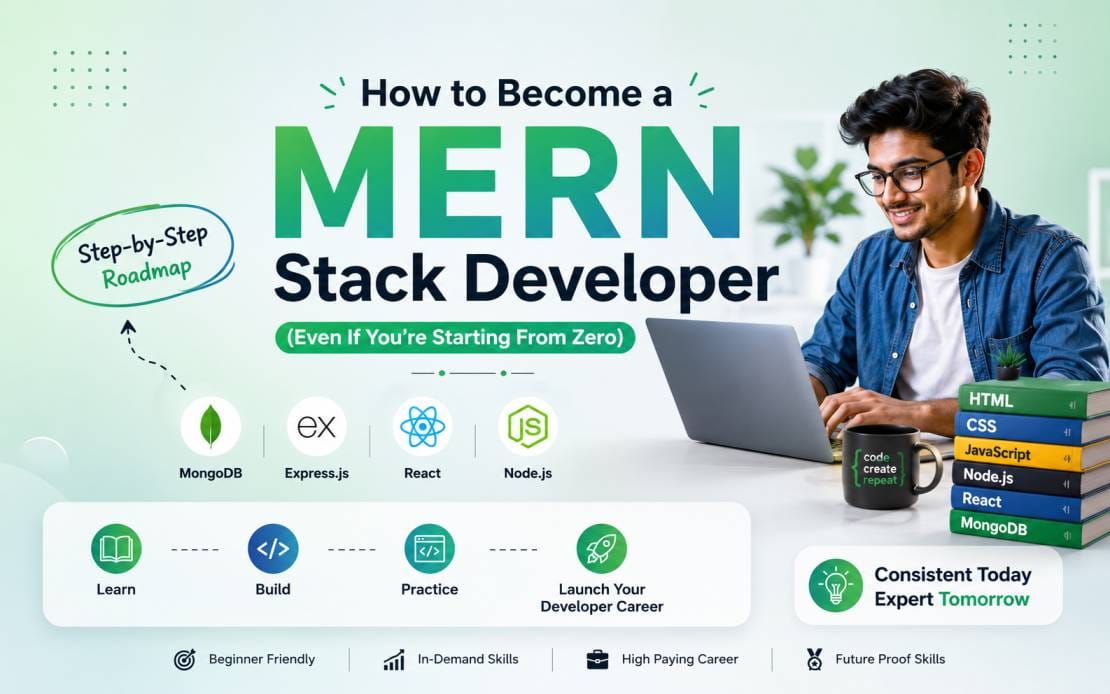
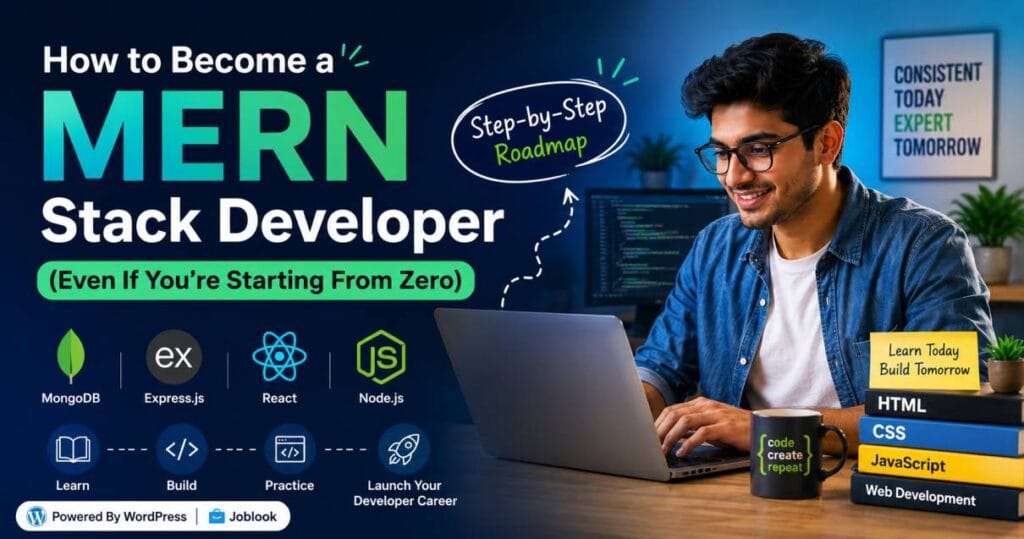
MERN stack full form: MongoDB, Express.js, React, Node.js.
That sounds technical. But here’s what it means in practice.
You’re learning how to build websites and web applications from front to back. The part users see and click on (React). The part that handles data, logins, and business logic (Node.js + Express). And the database that stores everything (MongoDB).
Think of it this way. React is the restaurant counter where customers place orders. Node and Express are the kitchen staff cooking and managing requests. MongoDB is the storage room with all the ingredients.
MERN stack developers build the entire restaurant. Not just the kitchen. Not just the counter. Everything.
That’s why companies like hiring them. You’re not a “frontend person” or a “backend person.” You can build features end-to-end. And in startups and mid-sized companies, that flexibility is gold.
Who Should Actually Choose This Career?
Let me be honest with you.
You’ll enjoy MERN stack development if:
- You like solving puzzles. Debugging is 40% of this job, and if that sounds miserable, reconsider.
- You have decent patience. Things will break. Code won’t run. You’ll miss a semicolon somewhere and spend an hour finding it.
- You enjoy seeing things work. There’s real satisfaction in building a feature from scratch and watching it come alive.
- You can learn independently. Nobody will hold your hand after the first few months.
You might struggle if:
- You need constant structure and deadlines from someone else.
- You hate looking things up. (Seriously, Googling errors is a core skill.)
- You want “quick money” without putting in the learning hours.
- Abstract thinking frustrates you. JavaScript does weird things sometimes.
Here’s a reality check. I’ve seen career switchers – people from teaching, retail,甚至是 drivers – become competent MERN developers faster than some CS graduates. Why? They were hungry. They built things constantly. They didn’t wait for permission.
So don’t let your background stop you. But also don’t romanticize it. This takes work.
Skills Required – What You Actually Need to Know
Let’s separate hype from reality.
Technical Skills (The Non-Negotiable List)
| Skill Level | What You Must Know |
|---|---|
| Beginner | JavaScript (ES6+), basic HTML/CSS, Git fundamentals |
| Intermediate | React hooks, state management, REST APIs, Node.js + Express basics, MongoDB queries |
| Advanced | Authentication (JWT, OAuth), deployment (AWS, Vercel, Netlify), performance optimization, testing |
JavaScript is the real foundation. Don’t rush this. I’ve interviewed people who “know MERN” but can’t explain how this works or handle async code properly. They didn’t get hired.
Spend real time here. Learn array methods. Understand promises and async/await. Know the difference between == and === in your sleep.
Soft Skills That Actually Matter
- Problem decomposition. Breaking a “build a dashboard” requirement into small tasks.
- Reading documentation. Not watching tutorials for everything.
- Asking good questions. “My API call fails” vs “I’m getting a CORS error when fetching from localhost:3000 to 5000 – tried adding headers but still blocked.”
- Basic communication. Explaining what you built and why.
Most bootcamps won’t teach you these. But they separate junior devs who get promoted from those who stay stuck.
Eligibility & Learning Paths – Do You Need a Degree?
Short answer: No.
Long answer: It helps, but not for the reasons you think.
With a CS degree: You’ll have an easier time with algorithms, system design, and getting past HR filters. But I’ve seen degree holders who can’t build real applications.
Self-taught path: Harder start. You’ll face more rejection. But once you have a solid portfolio and can pass technical interviews, nobody cares about your degree.
Bootcamp path: Works if you choose wisely. But don’t believe “guaranteed job placement” claims. Bootcamps teach you basics. You still need hundreds of practice hours.
Practical Learning Roadmap (6-12 Months)
Here’s what actually works for self-learners:
Months 1-2: JavaScript fundamentals. No frameworks yet. Build small things – a todo app, a calculator, a simple game. Use Git from day one.
Month 3: React basics. Build 3-4 small components. Understand props, state, and effects.
Month 4: Node.js + Express. Build a simple API that returns JSON data. Connect it to your React frontend.
Month 5: MongoDB. Learn CRUD operations. Connect your API to the database.
Month 6: Build one complete full-stack application. A blog platform, a task manager, a simple e-commerce cart. Deploy it.
Months 7-12: Build 2-3 more projects. Add authentication. Learn deployment properly. Start applying for jobs while continuing to learn.
This isn’t a race. Some people take 4 months. Some take 18. The market rewards competence, not speed.
Best Learning Resources (What’s Worth Your Time)
Free Quality Resources
- freeCodeCamp – Their JavaScript and Node.js sections are solid. No fluff.
- The Odin Project – Full-stack curriculum with a Node.js path. Project-based, which is how you actually learn.
- MDN Web Docs – Not a course, but your best friend for looking things up.
- Full Stack Open (University of Helsinki) – Advanced but excellent. Free certificate.
Paid Options (Worth the Money)
- Maximilian Schwarzmüller’s React course (Udemy) – Wait for a sale. Never pay full price.
- Jonas Schmedtmann’s Node.js course – Detailed, practical projects.
- Frontend Masters – Expensive but high quality. Good for intermediate/advanced learners.
YouTube Channels That Don’t Waste Your Time
- Traversy Media – Quick, practical videos. No 4-hour theory lectures.
- Web Dev Simplified – Explains complex topics simply.
- The Net Ninja – Good for beginners. Clear pace.
Practice Platforms
- Frontend Mentor – Realistic frontend challenges.
- LeetCode – Only after you’re job-ready. Not for beginners.
- Build your own projects – The best practice. Seriously.
What to avoid: Tutorial hell. Watching 50 hours of video without writing code. Don’t do that. Build something – anything – after every tutorial.
Common Beginner Mistakes (Learn From Other People’s Pain)
I’ve seen these patterns repeat for years.
1. Learning React before JavaScript.
You will struggle. Hard. Learn the language first, then the framework.
2. Copy-pasting code without understanding.
You’ll feel like you’re making progress until you need to build something alone. Then reality hits.
3. Ignoring Git and version control.
Every professional job uses Git. Learn it early. git add, commit, push, pull, branch – know these.
4. Building unrealistic portfolio projects.
A Netflix clone that doesn’t actually work? Not impressive. A simple but fully functional task manager? Much better. Recruiters check if your projects run.
5. Underestimating deployment.
If it’s not deployed, it doesn’t exist. Learn to put your apps online. Vercel, Netlify, Render – start with these.
6. Not reading error messages.
The error tells you exactly what’s wrong most of the time. Beginners panic. Pros read the stack trace first.
7. Comparing progress to social media devs.
That person who built Instagram in 2 days? Probably exaggerating. Or they have 10 years of experience. Focus on yourself.
MERN Stack Developer Salary – Realistic Numbers
Let’s talk money. Because you’re probably wondering.
| Experience Level | India (INR) | USA (USD) | Remote (Global) |
|---|---|---|---|
| Fresher / Entry-level | 3 – 6 LPA | 55k – 75k | 20k – 40k |
| Mid-level (1-3 years) | 6 – 12 LPA | 75k – 110k | 40k – 70k |
| Senior (3-6 years) | 12 – 22 LPA | 110k – 150k+ | 70k – 120k |
| Lead / Architect | 22 – 40 LPA+ | 150k – 200k+ | 120k+ |
Important caveats:
- These vary wildly by company, city, and your negotiation skills.
- Remote jobs often pay less than in-office in expensive cities, but more than local rates in smaller towns.
- Freelancing MERN stack developers can earn 20k – 1L+ per project depending on complexity.
- Don’t believe “earn 20 LPA as a fresher” YouTube videos. That’s the exception, not the rule.
Salary growth tip: The biggest jumps happen when you switch jobs, not from annual raises. After 18-24 months, start looking.
Job Market & Future Scope – Honest Take
Good news: MERN stack is not going away. React dominates frontend. Node.js has massive adoption. Companies need people who can build full applications without hiring five specialists.
The reality: Entry-level is crowded. Really crowded. Bootcamps and online courses have produced thousands of junior developers.
So how do you stand out?
- Build real projects that actual people could use. Not tutorial clones.
- Contribute to open source – even small documentation fixes show initiative.
- Learn adjacent skills – basic DevOps (Docker, CI/CD), TypeScript, Next.js. These make you more valuable.
- Network genuinely – Attend local meetups (or virtual ones). Help people. Don’t just ask for jobs.
Future trends worth watching:
- Next.js (React framework) is growing fast.
- TypeScript is becoming standard, not optional.
- Serverless and edge computing will change how we deploy.
But the fundamentals – JavaScript, REST APIs, databases, authentication – those won’t change for years.
Realistic Career Advice From Someone Who’s Been There
Here’s what I wish someone told me starting out.
The first job is the hardest to get. Once you have 6-12 months of professional experience, recruiters start reaching out. Before that, you’ll face rejection. That’s normal. Keep going.
You will feel imposter syndrome. Every developer does. Even seniors with 10 years of experience. The difference is they’ve learned to work through it.
Your portfolio matters more than your resume. I’ve hired developers with no degree and strong GitHub profiles over candidates with master’s degrees and empty portfolios.
Don’t avoid hard topics. Authentication, security, performance, testing – these are what separate juniors from mid-level developers. Learn them early.
The learning never stops. New tools emerge every year. If that sounds exhausting, this might not be for you. If you’re curious by nature, you’ll enjoy it.
Communication skills will take you further than coding skills. Can you explain technical decisions to non-technical people? Can you write clear documentation? Can you ask for help without sounding helpless? These matter hugely.
FAQ – Questions Beginners Actually Ask
Is MERN stack enough to get a job?
For entry-level, yes. But adding TypeScript and Next.js makes you much more competitive. Also learn basic deployment and Git workflow.
How long does it really take to become a MERN stack developer?
If you study 10-15 hours per week consistently: 6-9 months to be job-ready. Faster if you’re full-time. Slower if you have other commitments. Ignore anyone promising “become a developer in 8 weeks.”
Do I need to learn MongoDB specifically, or can I use SQL?
Learn MongoDB for MERN, but understanding SQL basics helps. Many companies use both. The core concepts (CRUD, relationships, indexing) transfer.
Is the market oversaturated for MERN developers?
Entry-level, yes. Mid-level and senior, no. Once you have experience and can prove you build real things, opportunities are plenty.
Can I get a remote job as a MERN stack developer from India?
Absolutely. Many global remote teams hire from India. But you’ll compete with candidates worldwide. Strong English communication and overlapping time zones help.
What’s the difference between MERN and MEAN stack?
MEAN uses Angular instead of React. Both use MongoDB, Express, Node.js. React is currently more popular, but Angular has its place in enterprise.
Should I learn Python instead of MERN?
Different use cases. Python is great for data, AI, and backend. MERN is for web applications. Choose based on what you want to build. Both have strong job markets.
Conclusion – Your Next Step
Here’s the honest truth.
Becoming a MERN stack developer won’t happen by watching tutorials in your free time while scrolling Instagram. It requires focused, consistent effort. You’ll get frustrated. You’ll feel stupid sometimes. That’s part of the process.
But if you stick with it – if you actually build things, push through the hard parts, and keep learning – this career can change your life. Decent money. Remote work options. The ability to build whatever you imagine.
Your specific next step today:
Open your browser. Go to freeCodeCamp or The Odin Project. Start the JavaScript section. Write your first line of code. Not tomorrow. Today.
Then do it again tomorrow. And the day after.
That’s literally all it takes. Small, consistent action over time.
You’ve got this.
One thought on “How to Become a MERN Stack Developer (Even If You’re Starting From Zero)”
Comments are closed.